The Stock You Think You Have Isn't the Stock You Have: Why Retail Chains Need ERP
Typical store stock records are right only about 63% of the time. See how ERP fixes inventory, POS, omnichannel and GST for retail chains, with a rollout plan.
Why retail chains need ERP
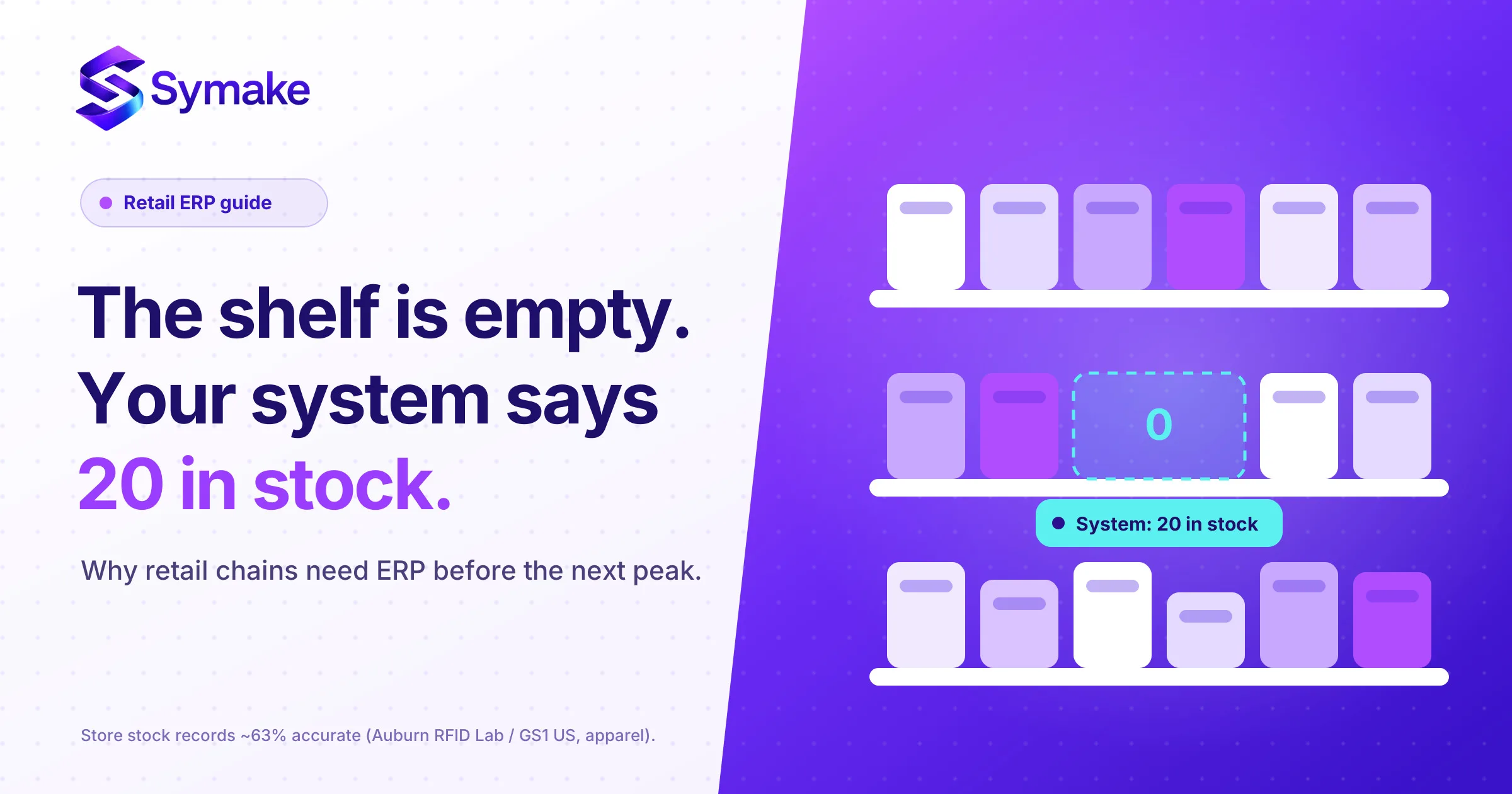
Here's a small experiment. Pick a fast-moving product in one of your stores. Ask the store manager how many they have. Then go and count.
I'd bet the numbers don't match. And I don't say that to criticise anyone. It happens in every retail business I've seen, because stock moves in a hundred small ways that a spreadsheet or a basic billing app never captures: a customer returns something to a different branch, a transfer is dispatched but not received, a damaged unit is set aside and forgotten, a barcode is scanned twice.
One study of apparel stores by the Auburn University RFID Lab and GS1 US put average inventory record accuracy at 63%. In other words, in a typical store, the system is wrong about more than a third of what's on the shelf. (A caveat: that figure is for apparel, and I found it in a contributed article by an RFID software vendor, so treat it as indicative rather than universal. The same research reports 95% accuracy once items are tagged individually, which tells you accuracy is fixable, and also that the people reporting it sell the fix.)
Now stretch that across 30 stores, a central warehouse, and a website that promises "in stock" to customers in real time. That's the problem retail ERP exists to solve. In this post I'll walk through what retail chains actually struggle with, what ERP changes, where it doesn't help, and how to roll it out without wrecking a trading season.
Why retail is a harder ERP problem than it looks
Retail looks simple from the outside: buy, stock, sell. In practice it has a combination of pressures that few other industries face together.
Thin margins, so small errors matter. When your margin is a few percent, a 2% stock write-off or a pricing mistake on a promotion can wipe out the profit on a whole category.
Huge numbers of SKUs and transactions. Thousands of items, variants (size, colour, pack), and hundreds or thousands of sales a day per store. Manual reconciliation isn't an option.
Multiple places holding the same stock. Stores, a warehouse, in-transit stock, returns, and online orders all draw from one pool. If these aren't one system, they're competing for the same units.
Fast-moving prices and promotions. Festive offers, bundle deals, store-specific pricing, loyalty discounts. A promotion configured wrongly in one store becomes a margin leak or a customer complaint.
Customers who don't care about your channels. Shoppers now check online, visit a store, buy on the app, and return at another branch. They expect all of it to just work.
Compliance that changes. In India, GST rates, e-invoicing and HSN handling mean every sale has a tax consequence that has to be right, every time.
India's retail market is growing quickly, which raises the stakes. IMARC estimates it at roughly USD 1.34 trillion in 2026, growing at about 12.8% a year through 2034, with online stores the fastest-growing channel at around 18.5% a year (though still only 11.6% of distribution as of 2025). Growth is good news, but it's also what breaks a business that is held together by manual processes.
What ERP actually fixes in a retail business
1. One inventory number across every location
This is the foundation. ERP keeps a single stock ledger across stores, warehouses and in-transit inventory, updated as things happen: every sale, receipt, transfer, return and adjustment posts to the same place.
You still need disciplined counting, but now there's a trustworthy system to count against. You can answer "how many do we have, and where?" with something better than a phone call. Stock transfers between stores become tracked movements (dispatched, in transit, received) rather than two managers agreeing on WhatsApp.
The cost of getting this wrong is large. IHL Group's widely quoted 2018 research, reported by Retail Dive, estimated out-of-stocks cost retailers about $984 billion a year worldwide, and that shoppers could hit an out-of-stock on as many as one in three trips. That's an old figure from an industry analyst, so use it for scale, not precision. But anyone in retail will tell you the direction is right.
2. POS and back-office on the same system
When the point of sale is a separate product from your accounting and stock system, someone (or some nightly job) has to move the data across. Errors creep in, and the numbers are always a day late.
When POS is part of, or tightly integrated with, the ERP, a sale at the till reduces stock, posts revenue, calculates GST and updates the customer record immediately. Day-end closing becomes a check, not a reconstruction.
3. Omnichannel without overselling
If your website shows stock from a separate count to your stores, you will eventually sell the same item twice. ERP lets online and offline share one inventory pool, so the website reflects what's genuinely available and an order can be fulfilled from the warehouse or from the nearest store.
This is also what makes click-and-collect, ship-from-store and "check availability in your branch" possible. They aren't features you bolt on. They're a consequence of having one stock truth.
4. Smarter purchasing and replenishment
Many retail chains buy by gut feel and the loudest store manager. ERP gives you sales history, current stock, supplier lead times and reorder rules in one place. You can set minimums per store, generate purchase orders from actual demand, and spot slow movers before they become a markdown problem.
This is where working capital gets freed. Less money stuck in stock that isn't moving, fewer stockouts on what is.
5. Pricing and promotions you can control
Central price lists, store-specific overrides, scheduled promotions with start and end dates, and approval controls over who can discount what. The point is consistency: the offer your marketing team designed is the offer the till applies, in every store, and ends when it should.
6. GST and finance that close on time
Every sale carries tax. An ERP applies the right GST rate by product and state, produces compliant invoices, and keeps the data ready for returns. We covered the broader compliance principle in how integrated systems eliminate manual compliance risks. In retail, with thousands of low-value transactions a day, that automation is the difference between a clean month-end and a week of reconciliation.
7. Visibility you can act on
Sales by store, category and time of day. Margin by product. Stock ageing. Shrink and variances by location. When these come from live data rather than month-end spreadsheets, a regional manager can act this week rather than explain it next quarter.
What ERP won't fix on its own
I'd rather be upfront about this than have you find out later.
Bad counting discipline. ERP is only as accurate as what goes in. If receipts aren't scanned, transfers aren't confirmed and cycle counts aren't done, the system faithfully records fiction. Technology like barcode scanners (or RFID for high-value categories) helps, but the process has to exist.
A weak product master. If the same item has three codes, or variants are set up inconsistently, every report is polluted. Clean item data before migration.
Staff who work around it. If store teams find the system slower than the old way during a busy Saturday, they will go back to the old way. Usability at the counter matters more than any dashboard at head office.
Missing links to the customer side. ERP knows what was sold. It doesn't automatically run your loyalty, campaigns or customer service. That's where a CRM comes in, and where integration between the two pays off.
Where Odoo fits for retail
We implement Odoo, so I'll tell you what I think it's good at and where to be careful.
Odoo's strength for retail is that point of sale, inventory, purchasing, accounting, e-commerce and CRM share one database. A POS sale, an online order and a purchase receipt all hit the same stock and the same ledger without a connector in between. That suits growing chains, multi-store retailers and brands that sell both offline and online, and the cost model (not charging per extra till-side user the way some platforms do) is friendlier as you add stores.
Where to be careful: very large retailers with hundreds of stores, highly specialised merchandising or planning requirements, or deep supply chain complexity should evaluate the specialist retail platforms and the large ERP vendors alongside Odoo. And in every case, resist heavy customisation. Retail changes fast, and every custom module is something you pay to maintain and upgrade. Our Odoo 20 upgrade guide explains why. If you're comparing platforms, Salesforce vs. Odoo by business size and budget is a good place to start, and our wider piece on why large companies need ERP covers the enterprise case.
How to roll out retail ERP without breaking trading
Retail doesn't get to pause. These are the principles I'd hold to.
Don't go live in peak season. Avoid the weeks around Diwali, year-end sales or any major promotion. The best go-live windows are the quieter weeks after a peak, when a hiccup is survivable.
Pilot with a few stores first. Pick two or three representative stores (not the biggest, not the smallest), run them for a few weeks, fix what breaks, then roll out in waves. A phased approach turns a risky switch into a series of small ones.
Clean the product master before anything else. Item codes, variants, units, tax categories, barcodes. This single step prevents more downstream pain than any other.
Start with the flows that leak money. Usually that's inventory accuracy, purchasing and POS-to-stock posting. Add advanced pricing, omnichannel and analytics once the basics are stable.
Train at the counter, not in a conference room. Cashiers and store staff should practise on real devices, with real barcodes, in the real environment, including the awkward cases: returns, exchanges, split payments, price overrides.
Run a physical count at cut-over. You want the system to start from reality. A full count (or a structured cycle count by category) before go-live gives you a clean opening balance.
Measure a few things. Stock record accuracy on cycle counts, stockout rate on top sellers, days of inventory, shrink by store, and the time it takes to close the day. If those improve, the project is working.
And if you're still deciding whether the effort is worth it, the cost of staying on disconnected systems is real even when no invoice shows it.
Conclusion: In retail, trust in the number is the whole game
Retail runs on a very simple promise: the thing you want is here, at this price, right now. Every part of that promise depends on one number being right, which is how much stock you have and where.
ERP doesn't make shoppers walk through the door. What it does is make sure that when they do, or when they open your app, the shelf, the system, the price and the tax all agree. For a growing retail chain, that's the difference between scaling smoothly and scaling your problems.
At Symake, we implement Odoo for retail and trading businesses, including POS, multi-store inventory, e-commerce and GST, and we plan rollouts around your trading calendar instead of ours. If you're running several stores and still reconciling stock by phone call, talk to our team. We'll start with a look at how stock actually moves in your business before recommending a thing.
People Also Ask (FAQs)
Why do retail businesses need ERP?
Retail combines thin margins, thousands of SKUs, stock held in several places, fast-changing prices and promotions, and tax rules that must be applied to every sale. ERP gives one stock ledger, integrated POS and accounting, controlled pricing and automated GST, so errors are caught early and decisions use live data.
What is retail ERP?
Retail ERP is enterprise resource planning software configured for retail operations. It typically covers point of sale, multi-location inventory, purchasing and replenishment, pricing and promotions, e-commerce and omnichannel orders, accounting and tax, and reporting, all on one shared data set.
How accurate is inventory in retail stores?
Often less accurate than managers believe. Research by the Auburn University RFID Lab and GS1 US found average inventory record accuracy of about 63% in apparel stores, rising to 95% with item-level RFID. That is category-specific and reported through a vendor-contributed article, so treat it as indicative. Accuracy depends mostly on process discipline: scanning, transfers and regular cycle counts.
Can ERP integrate with a retail POS and an online store?
Yes. Platforms like Odoo include POS and e-commerce in the same system as inventory and accounting, so sales from stores and the website draw from one stock pool. Other ERPs integrate with third-party POS and e-commerce platforms through APIs or connectors, which adds cost and testing.
Is Odoo good for retail chains?
For growing and mid-sized retail chains, multi-store retailers, and brands selling both offline and online, Odoo is a strong option, since POS, inventory, purchasing, accounting and e-commerce share one database. Very large retailers with hundreds of stores or specialised merchandising and planning needs should also evaluate dedicated retail platforms and the larger ERP vendors.
How does ERP help with GST in retail?
It applies the correct GST rate by product and state at the point of sale, generates compliant invoices, and keeps tax data organised for returns, which removes a lot of manual reconciliation across high volumes of small transactions. Rules change often, so confirm your configuration with your tax advisor.
How long does a retail ERP implementation take?
It depends on the number of stores, product range and integrations. A focused implementation for a small chain can take a few months, while larger multi-store rollouts take longer. A phased approach, piloting in a few stores and then rolling out in waves outside peak trading periods, reduces risk.