The Compliance Failure That Never Announces Itself
No business ever plans to fail an audit. Nobody schedules a data breach. Nobody budgets for regulatory fines. And yet, year after year, businesses across every industry pay heavily for a problem that was entirely preventable — not because they lacked good intentions, but because their compliance processes lived in spreadsheets, email threads, and someone's personal filing system.
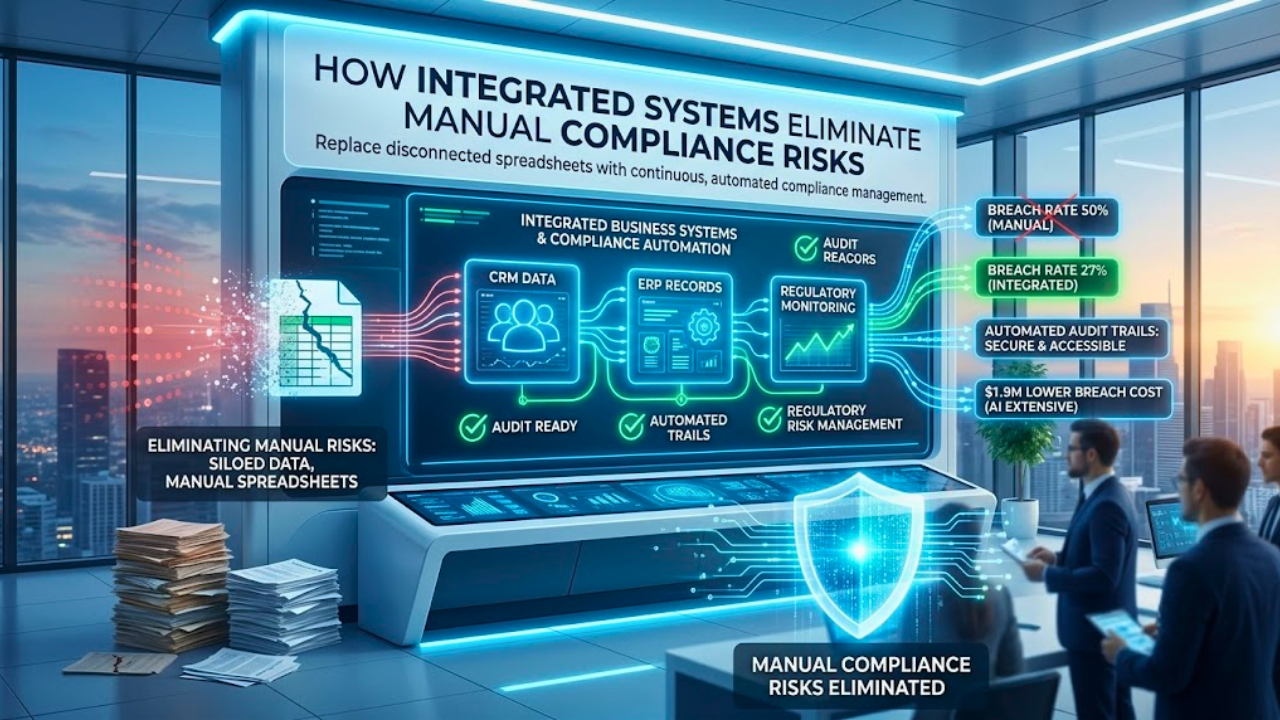
Manual compliance risks are not a future threat — they are a present, measurable, and expensive reality. According to Hyperproof's 2026 IT Risk and Compliance Benchmark Report, organisations managing risk on an ad-hoc, manual basis experienced a data breach rate of 50% in 2025, compared to just 27% for organisations using an integrated, automated approach. That is not a marginal difference. It is nearly double the exposure, tied directly to whether compliance runs on connected systems or disconnected spreadsheets.
This gap is why manual compliance risks have become one of the most urgent conversations in boardrooms today — and why integrated CRM and ERP systems have moved from a "nice to have" to a genuine risk-mitigation necessity. This article breaks down exactly how manual processes create compliance exposure, what the research says about the cost of that exposure, and how integrated systems close the gap.
What Are Manual Compliance Risks, Exactly?
Manual compliance risk refers to the exposure a business carries when its regulatory, financial, and data-governance processes depend on human-executed, disconnected tasks rather than automated, integrated systems. This includes spreadsheet-based tracking, email-based approvals, siloed departmental records, and any compliance workflow that relies on someone remembering to do something correctly, on time, every time.
The core problem is not human error in isolation — it is the absence of a system that catches human error before it becomes a compliance failure. A single missed update, an outdated spreadsheet version, or a policy change that never reached the right department can silently accumulate into significant regulatory exposure, long before anyone notices.
According to a 2025 academic study on ERP compliance risk, the other significant risk in ERP implementations is technical problems — system integration issues, information transfer complexities, and software verification problems — and lots of companies continue relying on legacy systems that were never built to handle today's regulatory complexity.
📊 The Research: How Big Is the Manual Compliance Problem?
The data across multiple 2025–2026 industry reports converges on a consistent and sobering picture.
Finding | Data Point | Source |
Breach rate for organisations managing risk manually/ad-hoc | 50% | |
Breach rate for organisations using integrated, automated risk management | 27% | |
Breach rate for large enterprises (5,000+ employees) in 2025 | 48% | |
Compliance professionals who say automation is the most effective way to cut compliance cost and complexity | 65% | |
Organisations using security AI/automation extensively | 32% | |
Lower average data breach cost for orgs using security AI extensively | $1.9 million lower | |
Faster breach identification/containment with security AI | 80 days faster | |
Total AML, KYC, and sanctions-related fines issued in 2025 | ~$4 billion | |
Organisations planning to increase GRC budgets in 2026 | 58% | |
Compliance technology market growth, 2024 to 2025 | $8.2B → $14.7B (79% increase) | |
Reduction in document processing time with AI compliance tools | 60–80% | |
The standout insight: the doubling of breach risk between manual and integrated compliance approaches is not a theoretical projection — it is measured, current, real-world outcome data from 2025 alone.
Why Manual Processes Create Compliance Risk by Design
1. Spreadsheets Have No Memory, No Audit Trail, and No Accountability
Spreadsheet environments lack enforceable role-based access, centralised approval workflows, and immutable change logs. Regulators and auditors increasingly expect organisations to demonstrate who modified a record, when, and under which methodology — and a spreadsheet simply cannot answer that question with certainty. Without this, organisations face documentation gaps during examinations, which represents a direct exposure under multiple supervisory frameworks.
This is not a hypothetical gap. It is the exact reason regulators penalise businesses even when no actual fraud or malicious intent existed — the absence of a demonstrable, auditable process is itself the violation.
2. Disconnected Systems Create Version Conflicts and Blind Spots
RegTech and integrated platforms eliminate manual re-keying and version conflicts by connecting directly with transaction monitoring, ERP, and CRM systems — capabilities that spreadsheet environments structurally cannot replicate at enterprise scale. When your sales data lives in one system, your finance data in another, and your compliance tracking in a third disconnected spreadsheet, nobody in the organisation has a single, trustworthy view of the truth. Each team is working from a different version of reality, and compliance failures hide in the gaps between those versions.
3. Compliance Has Shifted From an Annual Event to a Continuous Requirement
By 2026, compliance is shifting from an "annual event" to an "ongoing requirement," and organisations dependent on manual or fragmented systems will feel that shift the most. A once-a-year compliance review made sense when regulations changed slowly. It does not work when the average compliance professional must monitor 15–30 different regulatory sources simultaneously — Federal Register notices, state rule changes, industry guidance updates, and payer policy changes, all shifting continuously. Manual tracking simply cannot keep pace with that cadence.
4. Manual Third-Party and Vendor Risk Management Doesn't Scale
Managing complex third-party risks via disconnected spreadsheets introduces massive compliance liabilities, and a large share of organisations still use manual processes for third-party risk management — creating friction in vendor onboarding, delaying remediation follow-through, and making it harder to demonstrate consistency to auditors. As a business grows its vendor and partner ecosystem, the manual tracking burden grows exponentially, not linearly — until it becomes structurally impossible to manage reliably without a system doing the heavy lifting.
How Integrated CRM and ERP Systems Close the Compliance Gap
Centralised, Immutable Audit Trails
When CRM, ERP, and compliance workflows are integrated into a single connected platform, every action — every record update, every approval, every data change — is automatically logged with a timestamp and user identity. This transforms the audit process from a frantic, manual reconstruction of "who did what, when" into a simple, instant export. Enterprises typically observe measurably stronger audit trails, role-based access controls, and real-time regulatory responsiveness once they move away from spreadsheet-based tracking.
Real-Time Regulatory Monitoring Instead of Manual Vigilance
Modern integrated compliance platforms now use AI to monitor thousands of regulatory sources simultaneously, filter for relevance to the specific business, assess impact, and even recommend the specific action required — such as flagging that a policy update is needed by a specific date. This shifts compliance monitoring from something a person has to remember to do, to something the system does continuously, without fatigue or oversight gaps.
Automated Data Validation Prevents Errors Before They Compound
RegTech platforms automate data collection, validation, and reporting workflows, allowing organisations to adapt assessments quickly as risk conditions change — reducing manual effort while improving consistency across business units and jurisdictions. A field that's left blank, a mismatched customer record, or an incomplete KYC document gets flagged immediately — not discovered three months later during an audit, when the cost of fixing it (and potentially the reputational damage) is far higher.
Cross-System Consistency Eliminates the "Which Version Is Correct?" Problem
ERP systems increasingly integrate with CRM, billing, and other business applications — and when properly configured and tested, this integration ensures data flows in a controlled, validated way rather than existing as disconnected, conflicting copies across departments. Once sales, finance, and compliance are working from the same real-time dataset, the entire category of "which spreadsheet is the current one?" risk simply disappears.
Faster Incident Detection and Response
Organisations using security AI and automation extensively reported $1.9 million lower average data breach costs and 80 days faster identification and containment compared to organisations relying on manual processes. This speed differential matters enormously for compliance — many regulatory frameworks impose strict breach notification windows, and an organisation that takes weeks to even detect an incident is often already in violation before remediation even begins.
Real-World Example: What This Looks Like in Practice
Consider a 400-physician healthcare system that implemented AI-powered document intelligence for credentialing compliance in Q4 2025. Before integration, credentialing — verifying that every physician's licenses, certifications, and background checks were current and properly documented — took an average of 94 days per file, required 7 full-time compliance staff, and still produced survey findings for incomplete files.
After implementing an integrated, AI-assisted compliance system: average credentialing time dropped from 94 days to 38 days, compliance staff requirements dropped from 7 FTE to 3 FTE, and survey findings for incomplete files dropped to zero.
This is not an isolated result. Early adopters of AI-powered compliance document intelligence report a 60–80% reduction in document processing time across industries — the exact type of manual, repetitive, error-prone work that spreadsheet-based compliance processes were never designed to handle at scale.
The Business Case: Why This Isn't Just a Compliance Team's Problem
The Financial Exposure Is Direct and Substantial
Regulators issued nearly $4 billion in fines linked to AML, KYC, sanctions, and customer due diligence failures in a single year (2025). These are not abstract penalties — they are direct, board-visible costs that trace back, in most cases, to gaps in documentation, process consistency, and data governance that integrated systems are specifically designed to close.
Budget Momentum Confirms This Is a Strategic Priority, Not a Cost Centre
58% of organisations expect their GRC (Governance, Risk, and Compliance) budgets to increase in 2026, and 70% of companies now operate with annual GRC budgets exceeding $1 million. This is not defensive spending — it reflects a broader recognition that compliance infrastructure is now core operational infrastructure, not a back-office afterthought.
The Market Itself Is Signalling Where This Is Headed
The compliance technology market grew from $8.2 billion in 2024 to $14.7 billion in 2025 — a 79% increase — with projections reaching $32 billion by 2028. Every major compliance function will have AI-powered automation options within the next 18 months. Businesses that delay integration are not simply choosing to move slower — they are choosing to remain in the higher-risk category while their competitors and peers move into the lower-risk category.
How to Start Reducing Manual Compliance Risk in Your Business
1. Audit Where Your Compliance Data Currently Lives
Before selecting any system, map every place compliance-relevant data currently exists — spreadsheets, email approvals, standalone databases, personal files. This audit alone typically reveals the majority of the risk, because most businesses are surprised by how fragmented their compliance data actually is once it's mapped visually.
2. Prioritise Integration Over Point Solutions
A dedicated compliance tool that doesn't connect to your CRM and ERP simply creates another island of data. The research is consistent: the breach-rate advantage comes specifically from integrated, automated approaches — not from adding more disconnected tools to an already fragmented stack.
3. Build Role-Based Access and Immutable Logging From Day One
Every integrated system implementation should include enforceable role-based access controls and automatic change logging as a baseline requirement — not an optional add-on configured later. This is precisely the capability spreadsheet environments cannot replicate, and it is the single most commonly cited gap during regulatory examinations.
4. Treat Compliance as Continuous, Not Annual
Configure your systems for ongoing, real-time monitoring rather than periodic manual review cycles. The shift from "annual event" to "ongoing requirement" is already underway — and businesses still running annual compliance reviews are structurally behind the regulatory expectation curve.
People Also Ask
Q: What is the difference between manual compliance risk and integrated compliance management?
Manual compliance risk exists when regulatory and governance processes depend on human-executed, disconnected tasks — spreadsheets, email approvals, siloed departmental records — with no automated verification or audit trail. Integrated compliance management connects CRM, ERP, and compliance workflows into a single system where every action is automatically logged, data is validated in real time, and regulatory monitoring happens continuously rather than periodically. Research shows organisations using the integrated, automated approach experienced a data breach rate of just 27% in 2025, compared to 50% for those managing risk manually.
Q: How much does manual compliance risk actually cost a business?
The costs are both direct and compounding. Regulators issued nearly $4 billion in fines linked to AML, KYC, sanctions, and customer due diligence failures in 2025 alone — much of which traces back to documentation and process gaps that integrated systems are designed to prevent. Beyond fines, organisations without security automation reported data breach costs averaging $1.9 million higher than those with extensive automation, along with 80 additional days to identify and contain incidents — time during which exposure and reputational damage continue to accumulate.
Q: Can small and mid-size businesses benefit from integrated compliance systems, or is this only relevant for large enterprises?
The benefit is arguably more pronounced for smaller businesses, since they typically cannot afford large dedicated compliance teams to manually manage the growing complexity of regulatory requirements. Integrated CRM and ERP systems allow a small compliance function to achieve the consistency and audit-readiness that would otherwise require significantly more headcount. Additionally, since large enterprises with over 5,000 employees actually faced a higher 48% breach rate in 2025 due to broader attack surfaces, integration benefits scale across business sizes rather than being exclusive to large organisations.
Q: What industries face the highest exposure from manual compliance risks?
While every regulated industry carries exposure, financial services, healthcare, and any business handling significant volumes of customer data face the most acute risk due to frameworks like AML, KYC, GDPR, HIPAA, and SOX. Financial institutions specifically face continuous regulatory alert volume — since 2004, alert issuance has grown from roughly 10 per day to more than 220 per day industry-wide — making manual tracking increasingly unsustainable regardless of company size within these sectors.
Q: How long does it typically take to move from manual to integrated compliance processes?
Implementation timelines vary significantly based on the complexity of existing systems and the scope of integration required, but organisations report meaningful results even from partial deployments. In one documented case, a healthcare organisation reduced average processing time for a single compliance workflow from 94 days to 38 days within one quarter of implementing an integrated, AI-assisted system. The broader principle holds across contexts: integration delivers measurable risk reduction well before every legacy manual process has been fully replaced.
Conclusion: The Real Risk Isn't the Regulation — It's the System Underneath It
Every business owner already knows compliance matters. What often goes unrecognised is that the biggest source of compliance exposure isn't the complexity of the regulations themselves — it's the fragility of the manual systems businesses use to track them.
The research is unambiguous. Manual, ad-hoc compliance management nearly doubles breach risk compared to integrated, automated approaches. Nearly $4 billion in fines were
issued in a single year for failures that trace directly back to documentation and process gaps. And the compliance technology market's 79% growth in a single year signals a market-wide recognition that this shift is no longer optional.
Integrated CRM and ERP systems don't just make compliance easier — they make compliance structurally more reliable, by replacing memory-dependent, spreadsheet-based processes with automatic logging, real-time validation, and continuous regulatory monitoring. The businesses reducing their compliance risk fastest in 2026 are not the ones hiring more compliance staff. They are the ones building systems that make manual error close to impossible.
🎯 Ready to Eliminate Manual Compliance Risk in Your Business?
At Symake, we help founders and business leaders replace fragmented, spreadsheet-driven compliance processes with integrated CRM and ERP systems that build audit-readiness into every workflow — automatically. We handle the complete journey: compliance data audit, system integration, role-based access configuration, and automated audit trail setup — so your business is protected by design, not by chance.
Explore our CRM and ERP integration services →
Or get in touch with our team directly for a free Compliance Risk Audit — we'll map exactly where your manual processes are creating exposure and what an integrated system would look like for your business.
Learn more about us at www.symake.com.