Why CRM Matters More the Bigger You Get
At scale, a CRM stops being a sales tool and becomes your system of record for revenue, governance and AI. Here's why large companies can't run without one.
Ask a ten-person company why they have a CRM and you'll hear: "So we don't forget to follow up."
Ask a company with 5,000 people and you should hear something very different. If you hear the same answer, that's the first problem.
At small scale, a CRM is memory. It stores who you spoke to and what you promised. Useful, but if it disappeared tomorrow, the founder could rebuild most of it from their inbox and their head.
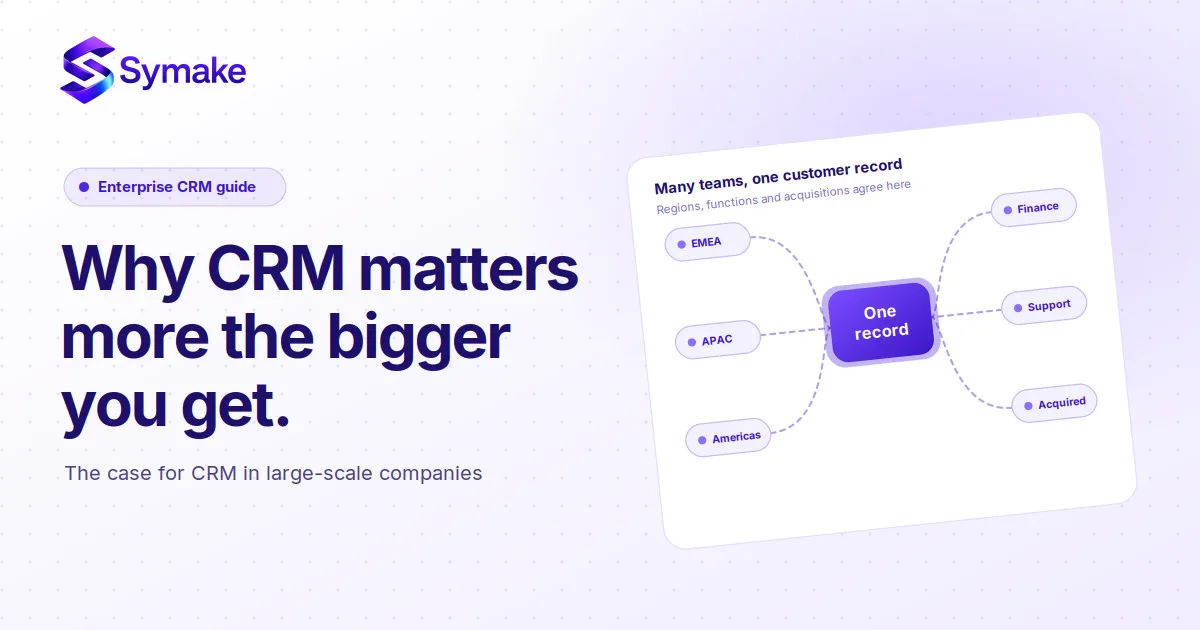
At large scale, nobody holds the whole picture in their head. There are eleven regional sales teams, four business units, three acquisitions that each brought their own spreadsheet, a finance team that needs numbers it can sign, and a board that wants a forecast it can trust. The CRM stops being memory and becomes something else entirely: the one place where the company agrees on who its customers are and what they're worth.
That shift is what this post is about. If you're sizing up a CRM for a large organisation, or wondering why the one you already have isn't delivering, this is the case as I'd make it across a table.
First, the honest numbers (and a warning about them)
Let me give you the figures people usually quote, and be upfront about where they're soft, because CRM statistics are some of the most over-quoted in business.
- The global CRM market is projected at about $126 billion in 2026 (Fortune Business Insights). Other analysts put it lower because they define "CRM" more narrowly, so treat it as a ballpark.
- Adoption among companies with 1,000+ employees is reported at over 91% (DemandSage, 2026). At that size, not having a CRM is the exception.
- Salesforce's 2026 State of Sales research found reps spend only about 40% of their time actually selling. The other 60% goes on admin, searching and internal coordination.
- A 2026 survey cited by Cyntexa found 76% of CRM users say less than half of their organisation's CRM data is accurate.
- Nucleus Research's re-analysis of 63 case studies put the return at $3.10 for every dollar spent, down from the famous $8.71 figure that dates back to 2014. If a vendor quotes you the old number, ask which year it's from.
Two things worth noticing. First, adoption is nearly universal at your size, so "should we have a CRM" isn't the real question. Second, the last two numbers say the gains are real but modest on average, and that bad data is the common failure. Most large companies already own a CRM. A lot of them aren't getting much from it.
That gap, between owning one and benefiting from one, is where almost everything below lives.
Why CRM becomes more important as you grow
1. It's the only place where "customer" has one meaning
In a large company, "customer" means different things to different teams. Sales means the account that signed. Finance means the entity that gets invoiced. Support means whoever raised the ticket. After an acquisition, the same company can be three records in three systems under three slightly different names.
Everything a large business wants to do (cross-sell, forecast, run account-based plans, report to the board) depends on those being the same customer. A CRM is where you enforce that. At ten people it's a nice-to-have. At ten thousand it's the foundation, because every other decision is built on top of it.
2. Forecasting stops being opinion
In a small team, the founder knows which deals are real. In a large one, the forecast is the sum of several hundred people's guesses, rolled up through four layers of management, each adding or shaving a bit.
A well-run CRM turns that into something you can interrogate. Which stage conversion rates have held for the last eight quarters? Which regions consistently over-forecast? How old is the average deal at each stage, and which ones are stale? You still need judgement, but you're applying it to evidence instead of to a spreadsheet someone assembled on Sunday night.
For a public company or one with investors, this matters beyond the sales floor. A forecast the finance team can trust is a forecast that gets built into hiring plans and guidance.
3. Governance and compliance can't live in inboxes
This is the one that surprises people, because it isn't glamorous. Large companies operate under rules: data privacy law, consent records, industry regulation, contract terms, approval limits on discounts. In an unstructured world, those rules are enforced by "please remember to."
In a CRM, they can be enforced by the system. Who's allowed to see which accounts. Who can approve a discount above a threshold. Where consent was recorded and when. An audit trail of who changed what. When a regulator or a customer's legal team asks a question, "let me check the system" is a far better answer than "let me ask around."
We've written about how integrated systems remove manual compliance risk. In large organisations, the CRM is usually the first place that discipline gets built.
4. It connects the front office to everything behind it
A big company's customer experience isn't made by sales alone. It's made by whether the order gets fulfilled, the invoice is right, the support team sees the history, and the account manager knows about the overdue payment before walking into a renewal conversation.
That only works when the CRM is connected to the ERP, finance, support and the rest. We covered the visibility side of this in How CRM and ERP Together Improve Business Visibility. At scale the point sharpens: the CRM isn't one system among many. It's the one all the others hang their customer data off.
5. It's what your AI is going to run on
This is the newest reason, and it's changing the conversation in boardrooms.
At Dreamforce 2026, Salesforce pushed hard on the CRM as the base layer for AI agents. Agentforce Coworker, described as an autonomous AI teammate that answers questions across the CRM, Slack and connected sources and can orchestrate other agents, is generally available now. Multi-agent orchestration, where one "superagent" coordinates specialist agents, including third-party ones, is on the roadmap. Salesforce's own 2026 research says 87% of sales organisations already use some form of AI.
Whatever you think of the hype, the direction is clear: agents act on the data in your CRM. If that data is duplicated, stale or contradictory, an agent doesn't politely pause. It acts on it, at speed, across thousands of accounts. We went deeper on this in what Dreamforce 2026 and Odoo 20 mean for growing businesses.
So the quality of your CRM is quickly becoming the quality of your AI. That's a very different stake from "did the reps log their calls."
What "important" looks like, versus what it usually looks like
Here is a pattern we see often in large organisations, so I'll describe it generally rather than as one client.
A company buys an enterprise CRM. The rollout is declared a success when the licences are assigned and the go-live party is held. Two years later, the regional teams still keep their own spreadsheets "because the CRM is slow," the sales leaders don't trust the dashboards, and finance still reconciles revenue by hand each month. The CRM exists, but the company runs on side channels.
Compare that with a company where the CRM is genuinely the backbone: one account hierarchy that matches how the business is organised, a short list of fields everyone agrees on and nobody can skip, pipeline stages with clear exit criteria, and leaders who run their weekly reviews from the CRM itself rather than from a deck. That second company isn't using fancier software. It made a handful of unglamorous decisions and held to them.
The software is rarely the difference. The discipline around it is.
Where big CRM rollouts quietly go wrong
If you're a large company, these are the traps I'd watch for.
Treating it as an IT project. A CRM at scale changes how hundreds of people work. If sales, finance, operations and legal aren't in the room from the start, you get a system that's technically correct and commercially ignored. Our guide to choosing a Salesforce implementation partner covers what good involvement looks like.
Customising before standardising. Every region wants its own fields, stages and process. Say yes to all of them and you've built eleven CRMs inside one. The harder, better move is to agree a global standard first and allow local variation only where there's a real regulatory or market reason.
Migrating the mess. Bringing duplicate accounts, dead contacts and inconsistent naming into a new system just gives you the same problem with a nicer interface. Clean before you move, not after.
Skipping integration. A CRM that doesn't talk to the ERP is a fancier address book. As we argued in the missing piece in most businesses, the value shows up where the systems connect.
Measuring licences, not usage. "5,000 seats deployed" tells you nothing. How many of them open the CRM daily, update opportunities themselves, and are measured on what's in it? That's the number that predicts return.
Ignoring the cost of doing nothing. Every month on fragmented data has a price, even if it never appears on an invoice. We broke that down in the true cost of not using a CRM or ERP.
So which CRM, and does it have to be Salesforce?
For very large, complex, multi-region organisations, Salesforce is usually the default shortlist entry, largely because of its depth on governance, ecosystem and the AI roadmap above. But it isn't the only route, and bigger isn't always better.
Odoo, for instance, is a serious option for large operations-heavy businesses, especially where you want CRM and ERP in one platform. If you're weighing the two, our comparison of Salesforce vs. Odoo by business size and budget lays out where each tends to win. The right answer depends on how complex your sales motion is, how much you need ERP in the same system, and how much you'll customise.
Whichever you choose, the lesson holds. The platform matters less than whether you've agreed what a customer is, who owns the data, and what "done" looks like at each stage.
Conclusion: At scale, the CRM is how the company agrees with itself
A small company can run on memory and goodwill. A large one can't, because no single person holds the whole picture anymore. The CRM is how the organisation builds one shared picture of its customers, its pipeline and its obligations, and increasingly, how it gives its AI something worth trusting.
That's why the case for CRM gets stronger as you grow, not weaker. And it's why the rollouts that disappoint almost never fail on technology. They fail on ownership, standards and data.
At Symake, we implement Salesforce and Odoo for businesses of every size, and we spend as much of our time on data standards and governance as on configuration, because that's where the return actually comes from. If you're planning an enterprise rollout, or you already own a CRM that isn't pulling its weight, talk to our team. We'll start with an honest look at what you have, before recommending anything.
People Also Ask (FAQs)
Why is CRM important for large companies?
At scale, no one person holds the full picture of customers, deals and obligations. A CRM gives the organisation one shared record of who its customers are, a forecast built on evidence rather than opinion, enforceable governance and compliance rules, and a clean data foundation for AI. Its importance grows with size because the cost of fragmented data grows with it.
What is the difference between a CRM for small businesses and for large enterprises?
Small businesses mainly need a place to track contacts, deals and follow-ups. Large enterprises also need account hierarchies across subsidiaries, role-based access, approval workflows, audit trails, multi-region and multi-currency support, integration with ERP and finance, and reporting that rolls up across business units.
How many large companies use a CRM?
Adoption is close to universal. Surveys cited by DemandSage in 2026 put CRM adoption among companies with 1,000 or more employees at over 91%. Adoption isn't the issue; getting real value from it is, since reported data accuracy and user adoption remain common problems.
What ROI can a large company expect from a CRM?
Published figures vary widely. Nucleus Research's 2023 re-analysis of 63 case studies found about $3.10 returned per dollar spent, well below the $8.71 figure from 2014 that is still often quoted. Treat any single number cautiously: results depend heavily on data quality, user adoption and integration with other systems.
How does a CRM support AI in a large company?
AI assistants and agents read from and act on CRM data. Salesforce's Agentforce, for example, is built to work across the CRM and connected systems. If the underlying records are duplicated or out of date, an agent will act on them anyway, so clean, governed CRM data is a precondition for AI that can be trusted.
Should a large company choose Salesforce or Odoo?
It depends on the complexity of your sales process, how much you need CRM and ERP in a single platform, and how much customisation you expect. Salesforce is often the default for large, multi-region, governance-heavy organisations. Odoo is a strong option for operations-heavy businesses that want CRM and ERP together. A short assessment of your processes is the most reliable way to decide.
How long does an enterprise CRM implementation take?
For a large organisation, expect several months rather than weeks, driven by data migration, integrations, role and security design, and training across regions. Phased rollouts, starting with one business unit or one high-value process, tend to be more successful than a single big-bang go-live.