As a founder, running a scaling business without clear, real-time data is like flying a high-speed jet blindfolded. You might have a powerful engine driving your sales, but without a functional dashboard, you cannot navigate the turbulence of supply chain issues, cash flow bottlenecks, or sudden customer churn.
This operational blindness stems from disconnected software. Your sales team lives in the Customer Relationship Management (CRM) platform, while your finance and operations teams live in the Enterprise Resource Planning (ERP) system. To solve this, establishing a robust CRM and ERP integration is no longer a luxury; it is a fundamental requirement. The stakes for getting this right are massive: the global CRM market is projected to reach $126.17 billion in 2026, while the ERP software market is estimated to surpass $83.2 billion in the same year. However, simply purchasing these platforms does not guarantee success.
When you integrate these systems, you stop relying on end-of-month spreadsheet reconciliations and start operating with real-time intelligence. This comprehensive guide breaks down exactly how connecting your front-office and back-office software transforms operational chaos into crystal-clear business visibility, empowering you to make confident, data-driven decisions.
The Silent Killer of Scale: Data Silos
Before understanding the technical solution, founders must recognize the operational disease: data silos. When your software systems do not communicate, your departments operate in alternate realities.
The financial impact of this disconnect is staggering. According to IDC Market Research, companies lose 20% to 30% of their annual revenue due to inefficiencies caused by data silos. Furthermore, Gartner reports that poor data quality costs organizations an average of $12.9 million annually.
Your sales team might celebrate closing a massive Q3 deal in the CRM. However, because they lack visibility into the ERP, they do not realize the warehouse is critically low on the necessary raw materials to fulfill that order. The result? Missed delivery dates, frustrated customers, and damaged brand reputation. When your CRM shows a customer as "highly engaged" while your ERP shows they are 60 days past due on payments, you set your business up for strategic missteps that damage relationships and sacrifice revenue.
Key Takeaway: Disconnected systems force your highest-paid talent to spend hours cross-referencing data manually, directly stifling your revenue growth and ballooning your operational costs.
What is CRM and ERP Integration?
To understand the foundational differences between these platforms before connecting them, you must know what each system is designed to do. For a deep dive into platform selection, read our guide on CRM vs ERP: What You Actually Need and When.
At its core, CRM software manages your front-office activities. It handles marketing campaigns, lead scoring, sales pipelines, and customer support interactions. It is the engine of revenue generation. Conversely, ERP software manages your back-office operations. It tracks inventory, supply chain logistics, manufacturing schedules, financial ledgers, and human resources. It is the engine of revenue fulfillment.
Integrating them means building a digital bridge—often through APIs (Application Programming Interfaces) or dedicated middleware—that allows data to flow seamlessly between the two in real-time. This creates an ERP CRM synergy where an action in one system automatically triggers the appropriate workflow in the other. While data integration projects can be complex, successful implementations have been shown to deliver an astonishing 328% return on investment (ROI).
How Integration Unlocks Unprecedented Business Visibility
When you integrate CRM and ERP systems, the concept of "visibility" moves from a corporate buzzword to a tangible operational asset. Here is exactly how this synchronization transforms your business landscape.
1. Achieving a 360-Degree Customer View
In a siloed business, the customer experience is fractured. The sales representative only sees the negotiation history, while the billing department only sees unpaid invoices.
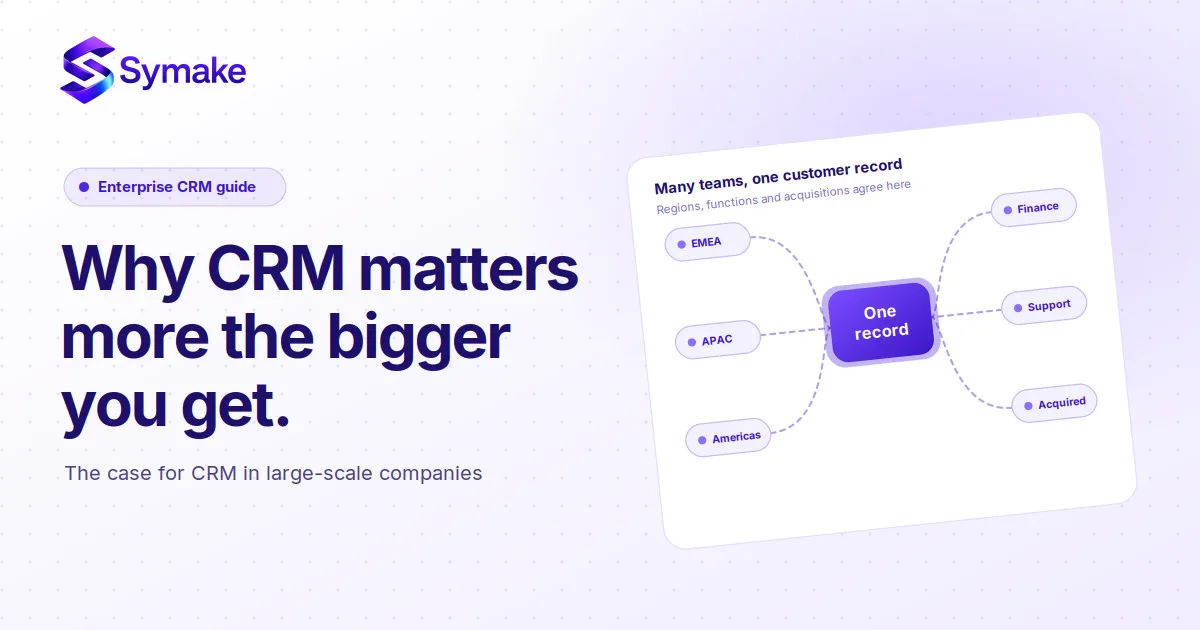
Integration consolidates this into a single, comprehensive record. When a sales rep opens an account in the CRM, they instantly see the client’s open support tickets, past purchase history, and current account balance pulled directly from the ERP. This unified view directly impacts the bottom line; industry benchmarks indicate that customer retention is boosted by around 25% when data silos are removed.
Key Takeaway: Total visibility allows your team to have highly contextual, informed conversations, turning routine customer service into proactive relationship management and upselling opportunities.
2. Real-Time Pipeline to Production Alignment
One of the most dangerous blind spots for a manufacturing or distribution founder is the gap between promised sales and actual production capacity.
With integrated systems, your sales team gains immediate business visibility into inventory levels and production schedules directly from their CRM interface. They can provide accurate, guaranteed delivery dates before a contract is even signed. Simultaneously, when a closed deal automatically creates an order in the system, customer, pricing, and product data are already validated, allowing inventory to be allocated in real time.
3. Precision Financial Forecasting
Founders rely on cash flow visibility to make hiring, expansion, and marketing decisions. If your revenue projections are based purely on CRM pipeline stages without factoring in ERP fulfillment costs and invoicing timelines, your forecasts are fiction.
Integration merges sales projections with historical fulfillment data. You can see exactly when a closed deal will realistically translate into cash in the bank. This eliminates the guesswork and allows leadership to navigate cash flow cycles with supreme confidence.
To understand how top-tier organizations leverage this exact kind of data architecture to leave their competitors behind, explore our insights on how to Scale Business with Systems: What Top Companies Do.
4. Eliminating Administrative Bloat
When a deal closes in a disconnected environment, a salesperson usually has to email operations, who then manually re-enters the client data, pricing, and terms into the ERP to generate an invoice.
This manual data entry introduces human error and delays fulfillment. By integrating the platforms, you eliminate data silos. The CRM pushes the exact contract details, SKUs, and pricing into the ERP automatically, generating an invoice and a fulfillment order in seconds. Industry data shows that integrated data workflows can lead to up to 70% faster reconciliation times.
Key Takeaway: Automating inter-departmental handoffs allows a lean operational team to handle enterprise-level volume without expanding headcount.
The Technical Pathways: How to Connect CRM and ERP
Once you commit to integrating your systems, you must choose the right technical approach. There is no one-size-fits-all solution, and the right choice depends on your budget, IT resources, and system complexity.
Native Connectors: Many modern SaaS platforms offer pre-built, native connectors. These are generally the fastest to deploy and require minimal coding. However, if your business processes are highly customized, a native connector might not support your specific, complex workflows.
Integration Platform as a Service (iPaaS): Solutions like MuleSoft or Boomi act as sophisticated middleware sitting between your CRM and ERP. They allow for highly customizable data flows, complex logic, and real-time synchronization. This is the gold standard for scaling mid-market businesses.
Custom API Integration: For legacy ERP systems or highly specialized setups, you may need developers to build a custom API integration from scratch. While this offers limitless customization, it is expensive to build and requires ongoing maintenance.
Actionable Advice: How to Approach Integration
Understanding the value of integration is easy; executing it requires strategic discipline. Here is how founders should approach the project to ensure a successful deployment.
1. Audit Your Existing Processes First
Never automate a broken process. Before touching any code or purchasing middleware, map out your current lead-to-cash workflow. Identify exactly where data gets stuck, where duplicate entry occurs, and what information your teams are constantly messaging each other to find. Focus on identifying your "Golden Datasets"—the critical 20% of data that drives 80% of your business decisions.
2. Define the System of Record
When two systems hold similar data (like a customer's address), you must define which system is the ultimate "source of truth." Typically, the CRM is the master record for prospect data and contact information, while the ERP is the master record for financial transactions, billing addresses, and product pricing.
3. Start with High-Impact Workflows
Do not try to integrate every single data point on day one. Start by integrating the workflows that cause the most friction. For most businesses, this is the "Quote-to-Cash" process. Ensure that when a quote is approved in the CRM, it seamlessly converts into a sales order in the ERP. Once that is stable, you can expand to inventory visibility and support ticketing.
The Hidden Costs of Doing Nothing
Founders often delay integration because they fear the initial setup time or technical complexity. However, the cost of inaction is exponentially higher.
When CRM and ERP do not talk, your teams become the integration layer—manually reconciling records and slowing execution to reduce risk. IDC research suggests that data professionals waste 30% of their time every week managing data quality issues that stem directly from information silos. In today's competitive landscape, agility is dictated by data clarity. Businesses that cannot see their data clearly simply cannot pivot quickly.
Conclusion: Transform Your Revenue Engine
Operational chaos is the enemy of scale. If you are paying your top-tier professionals to act as human bridges between disconnected software, you are artificially capping your own revenue potential.
A successful CRM and ERP integration transitions your infrastructure from passive databases into an active, intelligent revenue engine. By centralizing your data, eliminating manual handoffs, and creating a unified source of truth, you empower your entire organization to operate at its absolute peak.
Are you ready to stop losing revenue to operational friction and blind spots? It is time to design an architecture engineered for uncompromised visibility. Let us audit your current systems and build the infrastructure your growth demands.
Contact us today to schedule your strategy session.
People Also Ask (FAQs)
1. What is the main difference between CRM and ERP?
CRM (Customer Relationship Management) focuses on front-office tasks like driving sales, managing leads, and improving customer interactions. ERP (Enterprise Resource Planning) handles back-office processes like accounting, inventory management, supply chain, and human resources. While CRM helps generate revenue, ERP helps manage the cost and fulfillment of that revenue.
2. How does CRM and ERP integration improve data accuracy?
When systems are separate, employees must manually re-enter data from the CRM into the ERP, which inevitably leads to human error. Integration synchronizes the databases so that data entered in one system automatically updates in the other. This seamless connection can reduce manual errors by around 50%.
3. How much revenue do companies lose to data silos?
The financial drain of disconnected systems is severe. According to industry research, companies can lose between 20% and 30% of their annual revenue due to inefficiencies, missed opportunities, and delays caused by data silos.
4. Can a small business benefit from integrating CRM and ERP systems?
Absolutely. While large enterprises have complex needs, small businesses benefit immensely from the efficiency gains. Integration reduces the need to hire administrative staff for manual data entry and provides founders with enterprise-level visibility into cash flow and inventory, which is critical for surviving the early stages of rapid growth.
5. What is the typical ROI of a CRM and ERP integration?
While a poorly planned project can fail, a strategically executed data integration implementation can deliver a massive 328% ROI. These returns are realized through significantly shorter order-to-cash cycles, up to 70% faster reconciliation times, and a drastic reduction in fulfillment errors.