Many founders pride themselves on running lean operations. In the early stages of building a company, minimizing overhead is a survival tactic. However, there is a dangerous tipping point where being "lean" morphs into being structurally deficient.
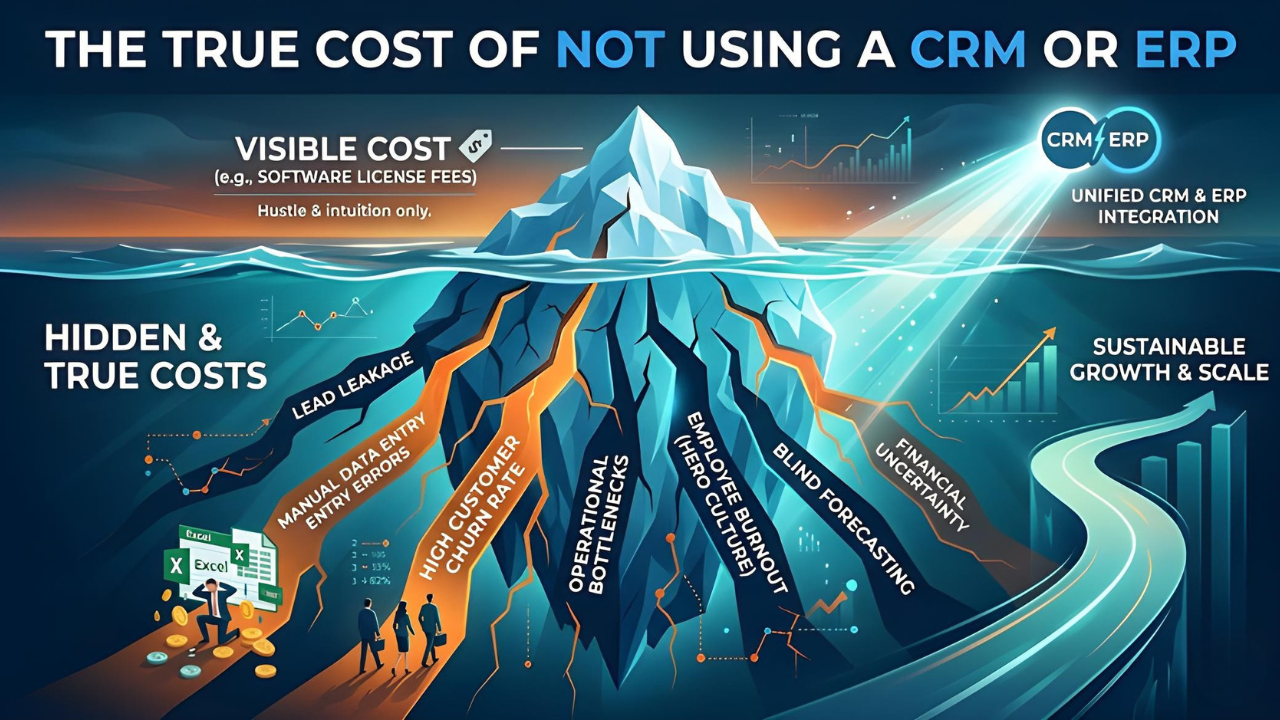
If you are delaying software investments to save a few thousand dollars a year, you are likely suffering from the cost of not using a CRM or ERP. This is the silent killer of growing businesses. Unstructured data, disconnected teams, and manual processes do not just slow you down; they actively bleed your profit margins.
In this article, we will expose the hidden financial, operational, and cultural penalties of relying on spreadsheets. We will break down exactly how disjointed systems create revenue leaks, and provide a clear roadmap for implementing the technology you need to scale your business sustainably.
The Illusion of "Free" Spreadsheets
When a business is new, spreadsheets are the default operating system. They are virtually free, easy to use, and customizable. However, spreadsheets were designed for static data analysis, not dynamic business management. As your company grows, a spreadsheet goes from being a helpful tool to a massive operational bottleneck. You end up with siloed information stored on individual hard drives. Version control becomes a nightmare. If a key employee leaves, they take their institutional knowledge, and their personalized Excel formulas, with them.
Key Takeaway: The money you save by avoiding software licensing fees is heavily outweighed by the money you lose in wasted labor, missed opportunities, and manual errors.
To understand how to transition your company away from these fragile processes, you must first structure business operations for scale. Without a structural foundation, even the best software will fail to deliver results.
The Front-Office Drain: The Hidden Cost of No CRM
Your front office, comprising marketing, sales, and customer service, is the engine of your revenue. A Customer Relationship Management (CRM) system is designed to supercharge this engine. Choosing to operate without one introduces severe hidden costs.
1. Lead Leakage and Missed Follow-Ups
In a B2B environment, it takes multiple touchpoints to close a deal. When sales representatives manage their pipelines in notebooks or Excel, follow-ups inevitably fall through the cracks.
Imagine a scenario where a high-value prospect requests a demo, but your top sales rep is out sick. Without a centralized CRM, the rest of the team has no visibility into the prospect's history, communication log, or specific pain points. The lead goes cold, and your competitor swoops in.
Key Takeaway: A CRM ensures zero lead leakage by automating follow-up reminders and providing a single source of truth for all customer interactions.
2. High Customer Churn Rate
Acquiring a new customer is significantly more expensive than retaining an existing one. Without a CRM, customer service teams cannot view a client's past purchase history, support tickets, or contractual terms quickly.
Customers hate repeating themselves. If they have to explain their problem to three different representatives because your data is disjointed, their frustration peaks. This directly contributes to a high customer churn rate. Losing a long-term client due to poor data management is a staggering, yet entirely preventable, hidden cost.
3. Blind Sales Forecasting
Founders need predictable revenue models to make hiring and expansion decisions. If your sales pipeline lives in the minds of your sales team, accurate forecasting is impossible.
You cannot confidently project next quarter's revenue based on "gut feelings." A CRM provides objective, real-time data on conversion rates, sales cycle lengths, and deal stages.
The Back-Office Bleed: The Hidden Cost of No ERP
While the front office drives revenue, your back office (finance, supply chain, inventory, and HR) protects your profit margins. An Enterprise Resource Planning (ERP) system is the central nervous system for these operations. The absence of an ERP creates catastrophic inefficiencies.
1. The Catastrophe of Manual Data Entry Errors
When your front-office sales software does not communicate with your back-office accounting and fulfillment systems, human beings are forced to bridge the gap.
Manual data entry errors are the most expensive mistakes a growing business can make. * A typo in a shipping address results in lost inventory and expedited replacement shipping costs.
By forcing highly paid employees to act as human data-pipelines, you are actively degrading your operational efficiency.
2. Inventory Disasters and Capital Tie-Ups
Inventory is essentially cash sitting on a shelf. If you do not have an ERP tracking your stock levels in real-time across multiple warehouses, you are flying blind.
This leads to two costly extremes:
Overstocking: Tying up vital working capital in slow-moving products to avoid running out.
Stockouts: Losing immediate sales and damaging brand reputation because you cannot fulfill customer demand.
An ERP optimizes your supply chain by predicting demand and automating reorder points.
3. Slow Financial Close and Lack of Cash Flow Visibility
If your finance team takes three weeks to close the books at the end of the month, your business is operating in the past. You are making critical strategic decisions based on outdated financial data.
Without an ERP, reconciling accounts across disparate departments requires monumental effort. You cannot scale a business if you do not know exactly how much cash you have on hand at any given moment.
Before you rush to purchase software, it is crucial to diagnose whether your pain points are rooted in the front office or the back office. We highly recommend reading our breakdown on CRM vs ERP: what you actually need (and when) to make an informed investment.
The Cultural Cost: Employee Burnout and Turnover
The financial penalties of missing systems are easy to quantify on a balance sheet. The cultural penalties are harder to measure but equally destructive.
The "Hero Culture" Trap
In companies lacking proper business management systems, operations only succeed because employees work excessive hours to manually patch the holes in the process. This creates a "hero culture."
While having dedicated employees is great, relying on them to manually cross-reference spreadsheets at 8:00 PM on a Friday is a failure of leadership. Top-tier talent will not stay in an environment where they are bogged down by repetitive, administrative drudgery.
Key Takeaway: Disconnected systems lead to employee burnout. Replacing top performers who leave due to frustration is a massive, hidden operational cost.
Lack of Departmental Alignment
When the sales team uses one tool and the fulfillment team uses another, an "us vs. them" mentality develops. Sales blames operations for slow delivery, and operations blames sales for promising unrealistic timelines.
A unified system forces departments to speak the same language and work from the exact same data set, fostering a culture of collaboration rather than conflict.
The Unified Solution: Building a Scalable Architecture
Recognizing the cost of not using a CRM or ERP is only the first step. The ultimate goal is to architect a technology stack where these systems do not just exist, but actively communicate with one another.
When you integrate a powerful CRM with a robust ERP, magic happens. A closed deal in your CRM instantly generates an invoice in your accounting software, updates your inventory levels, and triggers a fulfillment ticket in the warehouse, all without a single manual keystroke.
This level of operational excellence transforms your business from a fragile entity into a highly scalable machine. To learn exactly how to map this out, dive into our complete guide to business systems (CRM + ERP + Automation).
Conclusion
The true cost of not using a CRM or ERP is not just the money you lose today; it is the growth you sacrifice tomorrow. Every hour your team spends untangling spreadsheets, hunting down lost emails, or fixing manual data entry errors is an hour they are not spending on strategic, revenue-generating activities.
Scaling a business requires a rock-solid foundation. You cannot build a multi-million-dollar enterprise on a tech stack designed for a mom-and-pop shop.
Are you ready to stop bleeding profits and start scaling with confidence? At Symake, we specialize in helping founders identify their operational bottlenecks and deploy the perfect CRM and ERP solutions. [Contact our expert team today to schedule a free system audit and discover how we can automate your business for sustainable growth.]
Frequently Asked Questions (FAQs)
1. What is the biggest hidden cost of not using a CRM?
The biggest hidden cost is lead leakage. Without a CRM to automate follow-ups and track communications, warm prospects inevitably fall through the cracks, resulting in massive amounts of lost potential revenue.
2. How do manual data entry errors affect my business?
Manual data entry errors create a domino effect of hidden costs. They lead to incorrect billing, mis-shipped products, distorted financial reporting, and the requirement of additional labor hours simply to find and fix the mistakes.
3. At what stage should a startup invest in an ERP system?
A startup should consider an ERP when their operational complexity outgrows basic accounting software. If you are experiencing inventory stockouts, struggling with multi-channel order fulfillment, or spending weeks closing your monthly financials, it is time to upgrade.
4. Can I use a CRM to handle my back-office operations?
No. While CRMs are excellent for managing customer relationships and sales pipelines, they are not designed to handle complex supply chain logistics, inventory valuation, or heavy financial compliance. Attempting to use a CRM for ERP functions will lead to operational failure.
5. How do business management systems help scale a business?
Business management systems (CRMs and ERPs) allow your company to handle a significantly higher volume of transactions and customers without needing to hire a proportional amount of administrative staff. They automate repetitive tasks and provide the real-time data needed for strategic decision-making.