Most founders celebrate rapid revenue growth as the ultimate sign of success. However, sudden spikes in sales often mask a dangerous and silent reality. Without the right infrastructure, rapid growth is simply the fastest path to operational collapse. When sales outpace your ability to deliver, the cracks begin to show. Customer satisfaction drops, employees burn out, and profit margins erode. This is exactly why implementing robust business systems for growth is not a luxury, but a survival mechanism. If you are relying on spreadsheets, memory, and sheer willpower to run your company, you are sitting on a ticking time bomb.
In this article, we will explore why expanding companies implode, how to spot the internal warning signs, and how to build a scalable architecture that turns chaotic growth into predictable success.
The Growth Trap: Why More Revenue Doesn't Equal More Stability
It is a common misconception that businesses fail because they cannot acquire enough customers. In reality, many businesses fail precisely because they acquire too many customers too quickly. As noted by industry leaders, [a growth problem is often just a systems problem in disguise].
When a startup is small, brute force works. A founder can personally oversee every order, resolve every complaint, and manually update every ledger. But as the company scales, this hands-on approach becomes a massive liability. You cannot scale human intervention. Without scalable business processes, every new client adds exponential complexity rather than incremental value. The foundation buckles under the weight of its own success. To survive, leadership must pivot from working in the business to working on the business.
4 Signs Your Business is Breaking Internally
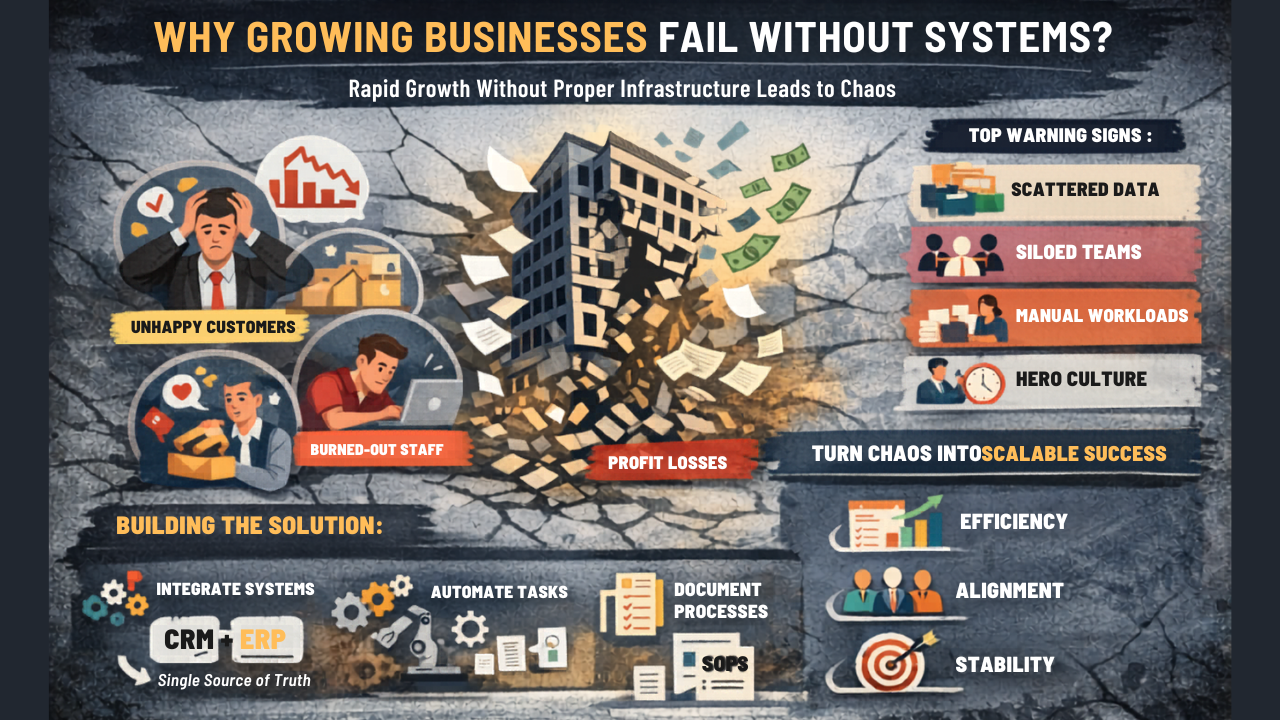
How do you know if your company is on the verge of an operational breakdown? The symptoms are usually felt long before they show up on a balance sheet. Look for these four critical indicators that your internal operations are failing.
1. Data Scattered Across the Void
Information is the lifeblood of any modern company. If your data is scattered across personal hard drives, endless email threads, and disconnected Excel files, your business is flying blind.
When data is siloed, there is no single source of truth. A sales rep might quote a price based on an outdated spreadsheet, while the warehouse struggles with inaccurate inventory counts. This fragmentation leads to duplicated efforts and catastrophic errors.
According to a McKinsey report, employees spend an average of 1.8 hours per day - more than 9 hours per week - searching and gathering information. If it takes your team hours to compile a simple weekly performance report, your data management is broken.
2. Teams Not Aligned (The Silo Effect)
As headcount grows, departments naturally begin to isolate themselves. Marketing generates leads, Sales closes them, and Operations tries to fulfill them. Without integrated systems, these departments operate like entirely different companies.
When teams are not aligned, the customer experience suffers. A client might be promised one thing by a salesperson, only to receive something entirely different from the fulfillment team. This misalignment breeds internal resentment and destroys customer trust. True alignment requires transparent, shared workflows where every department has real-time visibility into the pipeline.
3. The Chokehold of Manual Dependency
If your business requires an employee to physically copy data from one software application to another, you have a manual dependency problem. "Swivel-chair integration", typing data from one screen to the next, is the enemy of scale.
Manual dependencies throttle your growth speed. They introduce human error, delay critical actions, and waste thousands of hours of expensive payroll. If a key employee taking a two-week vacation causes your invoicing process to grind to a halt, your business is dependent on people, not processes.
4. The "Hero Syndrome" Culture
Does your company constantly rely on employees pulling late nights and weekends to hit deadlines or fix mistakes? Relying on heroics is a symptom of a broken system.
While dedication is admirable, a business cannot run on adrenaline indefinitely. Hero culture leads directly to severe employee burnout and high turnover rates. A healthy, scalable business operates predictably and quietly, without the need for constant emergency interventions.
The Anatomy of a Collapse: How It Happens
Operational collapse rarely happens overnight. It is a slow, agonizing process of compounding errors. Understanding the stages of failure can help you intervene before it is too late.
First, communication breaks down. As the volume of transactions increases, the scattered data makes it impossible to track promises made to clients. Orders slip through the cracks, and deadlines are missed.
Next, profitability plummets. To compensate for the chaos, companies often throw more bodies at the problem. Hiring more staff to manage inefficient, manual processes inflates payroll without actually solving the root cause. Revenue might be going up, but profit margins are shrinking.
Finally, the reputation shatters. Customers experience the internal friction firsthand. Bad reviews pile up, referrals dry up, and the very growth that sparked the chaos comes to a dead stop.
Building the Architecture: Business Systems for Growth
The only way to prevent this collapse is to build a unified technological ecosystem. You must replace human glue with digital infrastructure. Here is how to construct a foundation that scales. In order to grow the Business, leadership must pivot from working in the business to working on the business, which requires a deep understanding of your tech stack.
For a complete technical breakdown of how to design this architecture, read our [Complete Guide to Business Systems].
Centralizing with CRM and ERP Integration
Your first line of defense is standardizing your technology. A Customer Relationship Management (CRM) platform manages the front-house: sales, marketing, and client communication. An Enterprise Resource Planning (ERP) platform manages the back-house: inventory, finances, and supply chain.
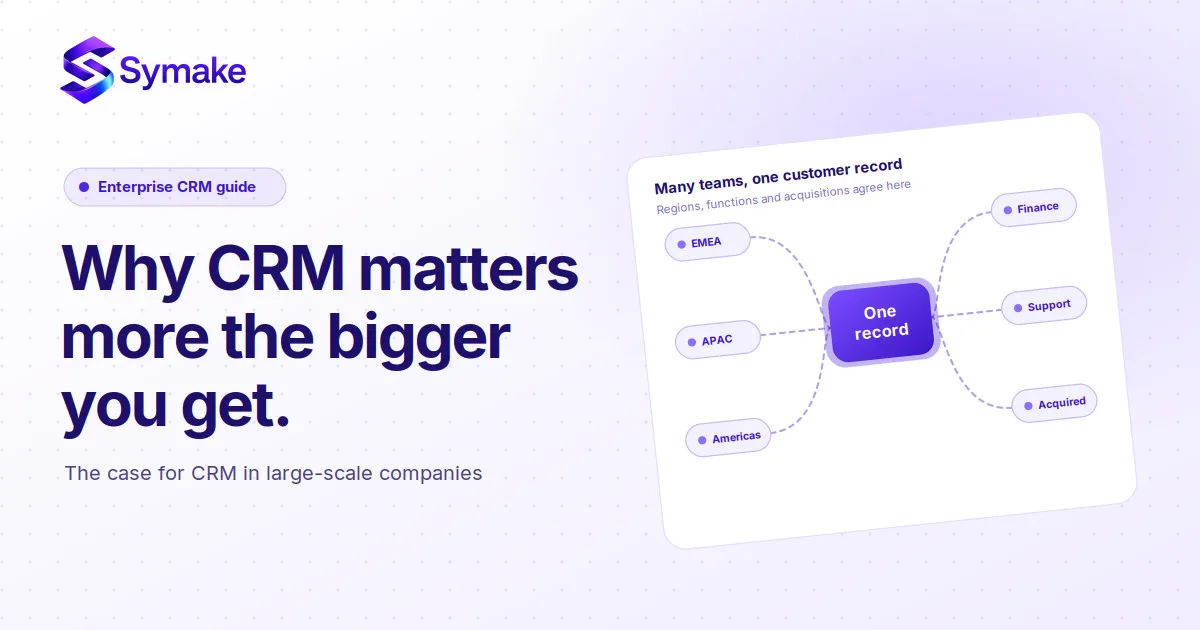
Integrating your CRM and ERP is the ultimate operational upgrade. When these systems talk to each other, a closed deal in the CRM automatically updates inventory in the ERP and triggers an invoice. This single source of truth eliminates scattered data and forces your teams to stay perfectly aligned.
Automating the Mundane
Once your core platforms are integrated, you must relentlessly automate repetitive tasks. Look at your team's daily workflows and identify the bottlenecks.
If a task requires no critical thinking, a machine should do it. Automate your lead follow-ups, internal task assignments, and payment reminders. By removing manual dependency, you free up your human capital to focus on high-level strategy, relationship building, and revenue generation.
Documenting Standard Operating Procedures (SOPs)
Technology is useless if your team doesn't know how to use it. You must document exactly how your business operates.
Clear SOPs ensure that processes are consistent, regardless of who is executing them. When you have a documented way to handle customer complaints, process payroll, and onboard new clients, you eliminate the "hero syndrome." Anyone can step in, follow the playbook, and achieve the desired result.
Actionable Steps to Rescue Your Operations Today
If you recognize the warning signs of collapse in your own company, you must take immediate action. Do not wait for the busy season to end; the chaos will only compound.
Conduct a Systems Audit: List every piece of software your team uses. Identify where data is duplicated and where communication breaks down.
Map the Customer Journey: Trace a client's path from the first marketing touchpoint to final fulfillment. Circle every step that relies on manual data entry.
Invest in Integration: Stop buying disjointed software subscriptions. Look for comprehensive platforms or expert consultants who can bind your tech stack together.
Growth should be exciting, not exhausting. By transitioning from manual chaos to integrated architecture, you build a company that can handle any volume of success.
Conclusion
Scaling a company is one of the most difficult challenges a founder will face. But as we have explored, the true threat to a growing business isn't a lack of sales, it is a lack of infrastructure. When data is scattered, teams are misaligned, and manual dependency rules the day, collapse is inevitable.
You cannot out-work a broken system. To secure your company's future, you must invest heavily in business systems for growth. By centralizing your operations with seamless CRM and ERP integration, you protect your profit margins and empower your team.
At Symake, we specialize in rescuing growing businesses from operational chaos. We build, customize, and integrate powerful CRM and ERP ecosystems tailored to your exact needs. Contact us today for a free systems audit, and let's build your blueprint for sustainable growth.
Frequently Asked Questions (FAQs)
1. What are the first signs that a business is breaking internally?
The earliest signs include an over-reliance on manual data entry, missed fulfillment deadlines, disjointed communication between sales and operations, and employees working constant overtime to fix avoidable mistakes.
2. Why is scattered data so dangerous for a scaling company?
Scattered data prevents leadership from making accurate, real-time decisions. It causes duplicated work, leads to embarrassing customer service errors, and makes it impossible to accurately forecast revenue or track inventory.
3. How do business systems for growth improve team alignment?
By integrating platforms like a CRM and an ERP, all departments work from a "single source of truth." When marketing, sales, and fulfillment share the same real-time dashboard, silos break down and everyone works toward the same objective.
4. What is manual dependency, and how do I fix it?
Manual dependency occurs when a process relies on a human to physically move data or trigger an action (e.g., copying an email into a spreadsheet). You fix it by using workflow automation tools and native software integrations to handle repetitive tasks instantly.
5. How does CRM and ERP integration prevent business collapse?
Integration connects your revenue generation (CRM) directly to your operational delivery (ERP). This ensures that you never sell inventory you do not have, automates your billing processes, and creates a seamless, error-free customer journey that scales infinitely.