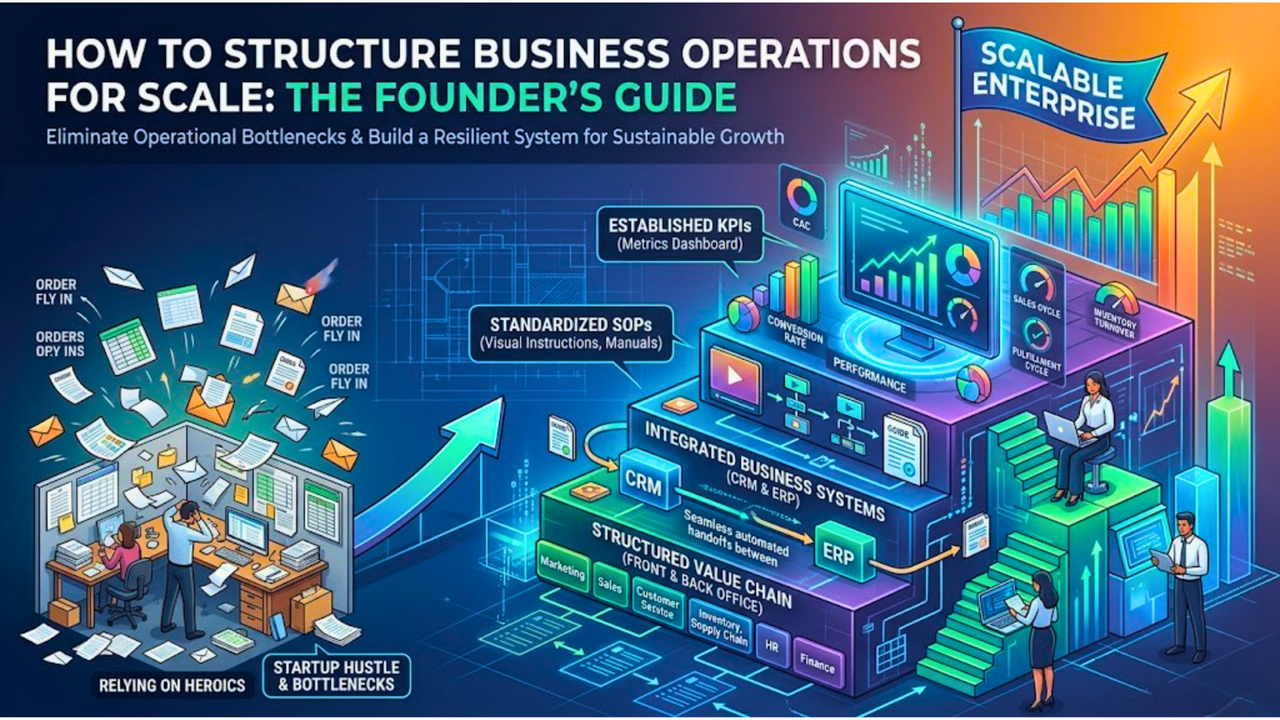
As a founder, the initial phase of building a company is fueled by hustle, intuition, and sheer willpower. But as revenue increases and your team expands, that same hustle becomes your biggest liability. You suddenly find yourself trapped in a web of miscommunications, lost data, and delayed fulfillment.
If you are wondering how to structure business operations to support rapid growth, you are not alone. Unstructured operations lead to profit leaks and employee burnout. To survive the transition from a scrappy startup to a mature enterprise, you must transition from relying on heroics to relying on systems.
In this article, we will break down the exact blueprint for organizing your company. We will explore how to eliminate operational bottlenecks, align your front and back offices, and deploy the right business management systems to ensure sustainable, long-term growth.
The Anatomy of Scaling: Why Most Operations Break Down
Before you can fix your operations, you have to understand why they are breaking. Operational bottlenecks occur when your sales velocity outpaces your fulfillment capacity. In the early days, everyone does a little bit of everything. The founder sells, the operations manager fulfills, and the finance team (often just one person) sends the invoices. But as you scale your business, these informal handoffs snap under pressure. Data gets trapped in individual spreadsheets, emails get lost, and customer satisfaction plummets.
To prevent this, you must build a resilient operational architecture. If you want to understand the exact moment your current tech stack becomes a liability, read our detailed breakdown on how business systems for growth stop operational collapse.
Step 1: Map Out Your Core Value Chain
The first step in structuring your business operations is mapping your value chain. Your value chain is the specific series of activities your company takes to turn a prospect into a paying, satisfied customer. You must separate your business into two distinct hemispheres:
The Front Office (Revenue Generation): This includes marketing, sales, and customer service. Their primary goal is to acquire and retain customers.
The Back Office (Fulfillment & Resources): This includes inventory, supply chain, human resources, and finance. Their primary goal is to deliver on the promises made by the front office efficiently and profitably.
Actionable Advice for Founders:
Sit down with your department heads and document the exact journey of a customer order. Where does the data originate? Who touches it? Where does it get stuck? Identifying these friction points is the foundation of a strong business operations strategy.
Step 2: Deploy the Right Business Management Systems
You cannot structure your business operations on whiteboards and sticky notes. Software is the digital concrete that holds your operational structure together. However, the most common mistake founders make is buying random software tools to solve isolated problems, resulting in a fractured "Franken-stack" of applications that do not communicate. To structure your business properly, you must deploy purpose-built platforms.
This is where the distinction between customer-facing and internal operations becomes critical.
If your front office is failing to track leads and close deals, you need a Customer Relationship Management (CRM) platform.
If your back office is losing track of inventory and profit margins, you need an Enterprise Resource Planning (ERP) platform.
Before buying any software, it is vital to understand the CRM vs ERP debate and what you actually need (and when). Choosing the wrong tool for your current growth stage will severely stunt your operations.
Step 3: Eliminate Silos with CRM and ERP Integration
Structuring your business operations is not just about putting teams in the right departments; it is about ensuring those departments speak the same language. Data silos are the enemy of scale.
When your sales team operates in a CRM and your finance team operates in a disconnected ERP or accounting tool, manual data entry becomes mandatory. This introduces a massive biological error floor. A salesperson typos an address, the warehouse ships to the wrong location, and the finance team bills the wrong amount. In fact, poor data quality costs the average organization $12.9 million every year.
To structure for true scale, you must integrate your core systems. The Power of Automated Handoffs:
When you achieve seamless CRM and ERP integration, the handoff between the front and back office becomes invisible.
A deal marked "Closed Won" in the CRM instantly triggers a fulfillment ticket in the ERP.
Inventory levels are updated in real-time, preventing sales reps from selling out-of-stock items.
Invoices are generated automatically without a single human keystroke.
For a deep dive into building this unified, automated architecture, explore The Complete Guide to Business Systems (CRM + ERP + Automation).
Step 4: Establish Key Performance Indicators (KPIs)
A structured operation must be measurable. If you cannot measure it, you cannot manage it. Establishing clear KPIs holds your departments accountable and provides early warning signs of operational bottlenecks.
Do not track vanity metrics. Focus on the numbers that actually drive profitability and efficiency.
Front Office KPIs to Track:
Back Office KPIs to Track:
When your business operations are properly structured and your software systems are integrated, these KPIs should populate automatically on a centralized dashboard, giving leadership real-time visibility into the health of the company.
Step 5: Standardize Standard Operating Procedures (SOPs)
Even with the best software in the world, human beings still run your company. Standard Operating Procedures (SOPs) are the instruction manuals for your business.
SOPs ensure that whether your top performer is handling a task or a new hire is on their first day, the output remains consistent.
How to Build Effective SOPs:
Keep them accessible: House them in a centralized, cloud-based knowledge base.
Make them visual: Use screen recordings, flowcharts, and screenshots rather than dense walls of text.
Update them regularly: Operations evolve. Your SOPs must evolve with them to remain relevant.
The ultimate goal of structuring your operations is to make the business run independently of the founder. Robust SOPs are the final piece of that puzzle.
Conclusion & Next Steps
Learning how to structure business operations is a continuous journey, not a one-time event. It requires a deep understanding of your value chain, the strategic deployment of business management systems, and a commitment to breaking down data silos between your departments.
When you align your people, processes, and technology, you transform your business from a fragile startup into a resilient, scalable enterprise. Are operational bottlenecks, disconnected data, and manual processes stunting your growth? At Symake, we specialize in helping founders architect scalable operations through expert CRM and ERP implementation and integration.
Stop letting poor systems limit your potential. [Contact our team today to schedule a free system audit and discover how we can automate your operations for scale.]
Frequently Asked Questions (FAQs)
1. What is the first step in structuring business operations?
The first step is to thoroughly map out your core value chain. You must document exactly how your business acquires customers (front office) and how it fulfills their orders (back office) to identify where the current friction points and bottlenecks exist.
2. Why is CRM and ERP integration so important for business operations?
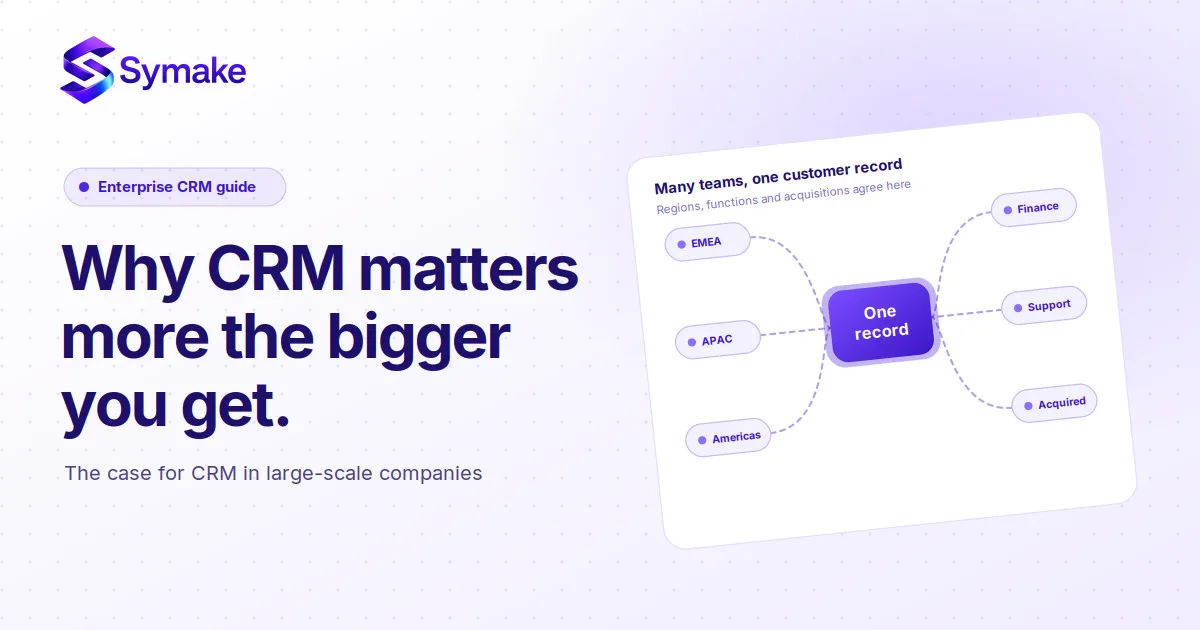
CRM and ERP integration eliminates data silos and manual data entry. It ensures that your sales team and your operations team are working from a single source of truth, reducing costly errors, speeding up fulfillment, and providing leadership with accurate financial data.
3. What are the signs of operational bottlenecks in a growing company?
Common signs include delayed order fulfillment, a high rate of manual data entry errors, sinking customer satisfaction scores, and a lack of real-time visibility into inventory or profit margins. If your revenue is growing but your profits are shrinking, you have an operational bottleneck.
4. How do business management systems help scale a business?
Business management systems, like CRMs and ERPs, replace chaotic manual processes with automated workflows. They allow your team to handle a significantly higher volume of customers and transactions without needing to hire a proportional amount of administrative staff.
5. How often should a company review its business operations strategy?
High-growth companies should review their business operations strategy at least quarterly. As you scale, the processes that worked for a team of 10 will fundamentally break for a team of 50. Continuous auditing ensures your software and SOPs evolve with your company's size.