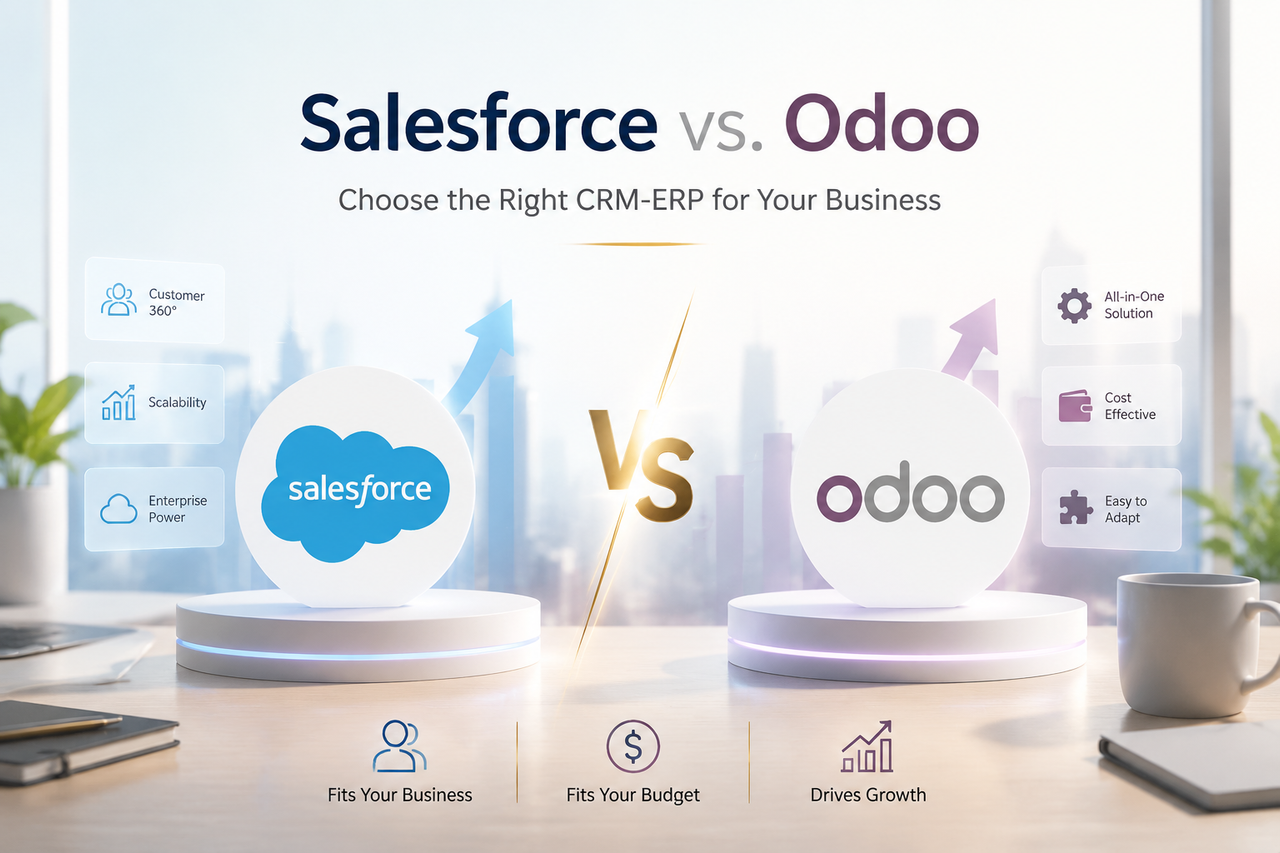
It’s one of the most common questions we hear from business owners and IT decision makers across South India: “Should we go with Salesforce or Odoo?”
And it’s the right question to ask. Both platforms are market leaders — but they solve different problems, at very different price points, for very different types of businesses. Choosing the wrong one doesn’t just waste money; it locks your team into workflows that fight against how your business actually operates.
At Symake, we’re in a rare position to answer this question honestly. As a company providing both Salesforce and Odoo services in South India, we implement both platforms every week — for manufacturers in Coimbatore, exporters in Kochi, tech startups in Bengaluru, and distributors in Chennai and Hyderabad. We have no incentive to push you toward either one.
This guide gives you the same framework we use in our consulting sessions to help businesses decide. By the end, you’ll know exactly which platform fits your size, budget, and growth stage.
The Fundamental Difference: CRM-First vs. Business-Suite-First
Before comparing features, understand what each platform fundamentally is:
Salesforce is the world’s leading CRM platform. It was built to manage customers, sales pipelines, marketing, and service — and does this better than almost anything on the market. ERP-style functions (finance, inventory, manufacturing) come through add-ons, integrations, or separate products.
Odoo is an integrated business suite. CRM is just one of 40+ apps that cover sales, purchasing, inventory, accounting, manufacturing, HR, e-commerce, and more — all built on one database, by one vendor, with one interface.
This single difference drives almost every other comparison below.
Quick takeaway: If your primary challenge is winning and keeping customers, Salesforce leads. If your challenge is running the whole business on one system, Odoo leads.
Salesforce vs. Odoo: Head-to-Head Comparison
1. Pricing and Total Cost of Ownership
Salesforce:
Per-user, per-month licensing that scales up with editions (Starter to Unlimited)
Costs grow quickly as you add products: Sales Cloud, Service Cloud, Marketing Cloud each carry separate licenses
Powerful, but the total cost of ownership is significantly higher — typically suited to businesses where each sales seat generates substantial revenue
Odoo:
Dramatically lower per-user pricing, with an all-apps model — one subscription covers CRM, accounting, inventory, and more
The Community edition is open source and free (self-hosted), making it the lowest-cost entry point in enterprise software
Implementation and customization are typically the larger cost components, not licensing
Verdict for Indian SMEs: For most small and mid-sized businesses in South India, Odoo delivers a far lower total cost of ownership. Salesforce justifies its premium when sales complexity and deal values are high.
2. Business Size Fit
Startups & small businesses (5–50 employees): Odoo is usually the better fit. You get CRM + invoicing + inventory + accounting in one system at a price a small business can sustain. Salesforce at this stage is often more firepower (and cost) than needed — unless you’re a sales-led SaaS or services startup where pipeline management IS the business.
Mid-market (50–500 employees): This is where the decision gets genuinely interesting. If your operations are complex (manufacturing, multi-warehouse inventory, projects), Odoo’s integrated suite shines. If your revenue engine is a large sales and service team managing high-value B2B relationships, Salesforce’s depth in pipeline analytics, forecasting, and automation pays for itself.
Enterprise (500+ employees): Salesforce dominates enterprise CRM for good reason — governance, security certifications, AppExchange ecosystem, and advanced AI (Agentforce, Einstein). Many enterprises run Salesforce for customer-facing teams alongside an ERP for operations. Notably, some enterprises pair Salesforce CRM with Odoo ERP — a stack Symake has implemented successfully.
3. Features and Depth
Where Salesforce wins:
Sales pipeline management, forecasting, and territory management
Marketing automation and customer journeys
Customer service and case management at scale
AI-driven insights and agentic automation
Massive third-party app marketplace (AppExchange)
Where Odoo wins:
True end-to-end coverage: quote → sales order → delivery → invoice → accounting, in one flow
Manufacturing (MRP), inventory, and purchase management built in
GST-compliant invoicing and Indian localization out of the box
Website builder and e-commerce integrated with inventory
Faster, cheaper customization due to open-source architecture
4. Implementation Time and Complexity
Odoo: Core modules (CRM, Sales, Invoicing, Inventory) can go live in 4–8 weeks for a typical SME. Phased rollouts let you start small and expand.
Salesforce: A well-scoped Sales Cloud implementation typically takes 6–12 weeks; multi-cloud enterprise projects run longer. The platform rewards investment in proper configuration and admin capability.
Either way, the implementation partner matters more than the platform. A poorly implemented Odoo will underperform a well-implemented Salesforce — and vice versa. This is why choosing an experienced Salesforce and Odoo implementation partner in South India is often the highest-leverage decision in the entire project.
5. Customization and Flexibility
Odoo: Open source means your development partner can modify almost anything. For businesses with unique processes, this is a major advantage — and development costs in India are highly competitive.
Salesforce: Extremely configurable through clicks (flows, objects, validation rules) and code (Apex, Lightning Web Components). Customization is powerful but happens within Salesforce’s proprietary framework, and specialized Salesforce developers command premium rates.
6. Local Compliance for Indian Businesses
This is where many international comparisons fall short. For businesses operating in India:
Odoo offers strong Indian localization: GST invoicing, e-invoicing, e-way bills, TDS, and Indian payroll — configurable out of the box or with light customization.
Salesforce is a CRM, so statutory compliance typically lives in your connected ERP or accounting system (Tally, Odoo, SAP) — making integration quality critical.
A local partner like Symake ensures compliance is designed in from day one, not patched in after go-live.
Decision Framework: Which Should You Choose?
Choose Odoo if:
You want CRM + ERP + accounting in one affordable system
You’re an SME or mid-market business watching total cost of ownership
Your operations involve inventory, manufacturing, or multi-department workflows
You need GST-compliant invoicing built into your core system
You want fast, cost-effective customization
Choose Salesforce if:
Sales and customer relationships are the core engine of your business
You manage complex B2B pipelines with long sales cycles and large deal values
You need best-in-class marketing automation and service management
You’re scaling toward (or already at) enterprise size
Advanced AI-driven sales intelligence is a strategic priority
Choose both if:
You’re a larger organization that wants Salesforce’s CRM depth for customer-facing teams and Odoo’s operational backbone for finance, inventory, and manufacturing. With a well-built integration, this hybrid stack offers best-of-both-worlds capability — and it’s a combination Symake specializes in connecting.
Common Mistakes to Avoid (From Real Projects)
Choosing by brand name instead of business fit. Salesforce’s market leadership doesn’t make it right for a 20-person trading company; Odoo’s low price doesn’t make it right for a 200-seat enterprise sales org.
Ignoring total cost of ownership. Compare 3–5 year costs including licenses, implementation, customization, training, and support — not just the monthly subscription.
Underestimating integration costs. If you choose Salesforce, budget for connecting it to your accounting/ERP system properly.
Skipping the discovery phase. A structured requirements study before purchase costs a fraction of what a wrong platform decision costs.
Choosing a partner by lowest quote. Implementation quality determines ROI. Ask for references from businesses of your size and industry.
Why Businesses Across South India Trust Symake
Symake provides Salesforce and Odoo services across South India — Kerala, Tamil Nadu, Karnataka, Andhra Pradesh, and Telangana — with a difference most vendors can’t offer: genuine dual-platform expertise.
Unbiased platform selection: Because we implement both, our discovery process recommends what fits your business — not what fits our sales target.
End-to-end services: Consulting, implementation, customization, data migration, integration, training, and long-term support under one roof.
Indian compliance built in: GST, e-invoicing, and statutory requirements handled from day one.
Local advantage: Same time zone, on-site availability, and a team that understands how South Indian businesses actually operate.
Whether you land on Salesforce, Odoo, or a hybrid of both, the goal is the same: a system your team actually uses, at a cost your business can sustain, that scales as you grow.
Frequently Asked Questions
Is Odoo a good alternative to Salesforce for small businesses in India? Yes. For most Indian SMEs, Odoo offers CRM plus complete business management (invoicing, inventory, accounting) at a fraction of Salesforce’s cost. Salesforce becomes the stronger choice as sales complexity and team size grow.
Can Salesforce and Odoo work together? Absolutely. Many businesses use Salesforce as their CRM and Odoo as their ERP/accounting backbone. Symake builds and maintains these integrations, syncing customers, orders, and invoices between the two platforms.
Which is easier to customize — Salesforce or Odoo? Odoo, being open source, is generally faster and cheaper to customize, especially with Indian development rates. Salesforce is highly configurable but customization happens within its proprietary framework at premium developer rates.
How much does Odoo implementation cost in India? It varies with modules, users, and customization needs. A core implementation for a small business is far more affordable than comparable enterprise platforms. Contact Symake for a transparent, itemized estimate after a free discovery call.
Does Symake provide support after implementation? Yes. We offer Annual Maintenance Contracts with defined SLAs covering support, upgrades, enhancements, and user training for both Salesforce and Odoo.