What Metabot’s 2026 updates mean for reporting, data quality and management decisions.
Imagine your monthly review starts with a straightforward question: “Which branches increased sales last month without reducing gross margin?”
The answer needs sales figures, product costs, returns and a consistent branch list. If someone has to collect those from separate systems before the discussion can continue, the meeting becomes another reporting request.
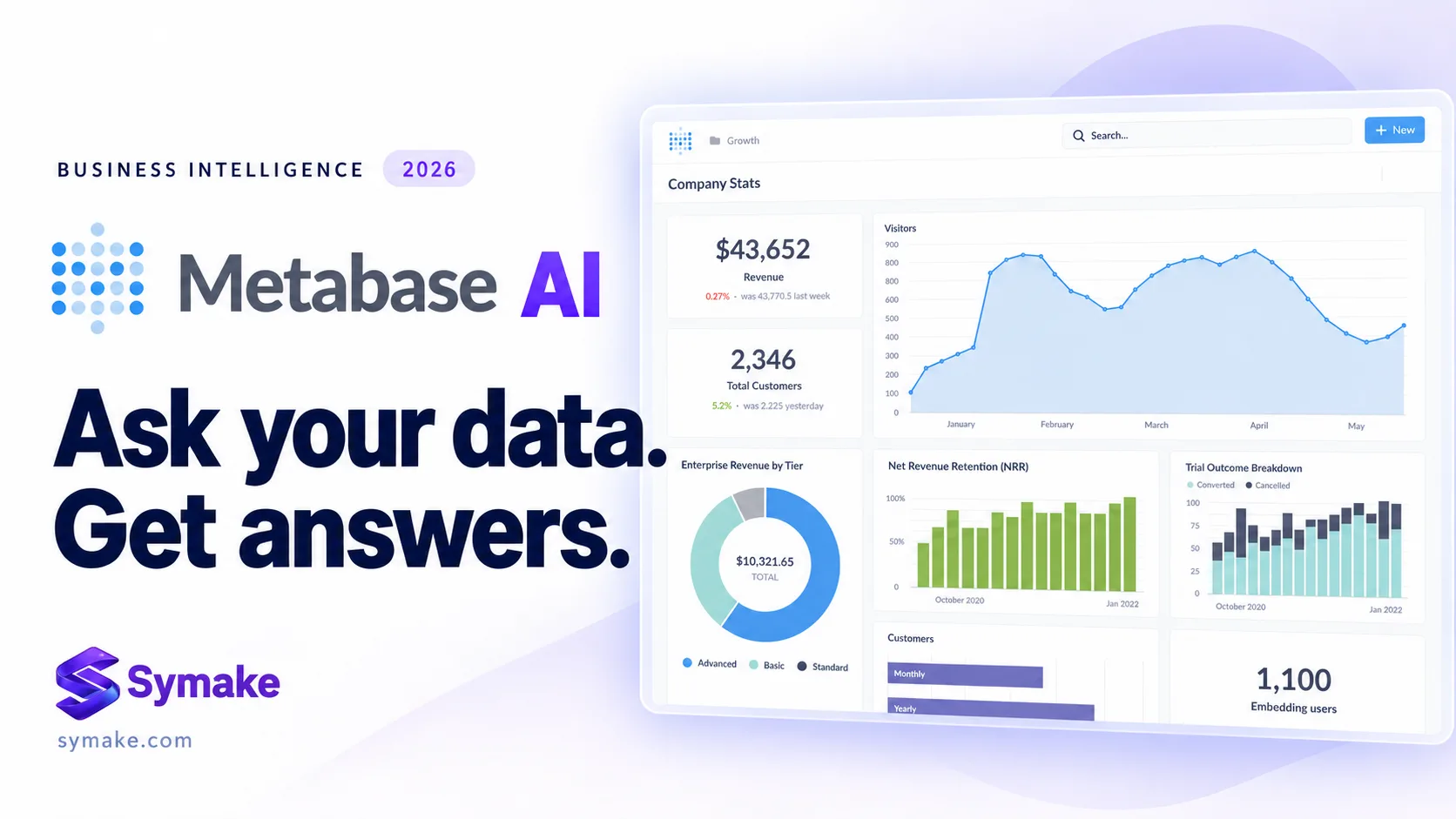
Metabase’s 2026 AI updates offer a way to shorten that cycle. Its assistant, Metabot, lets people ask questions about connected data in everyday language. Recent releases have expanded the choice of AI providers and added controls for organisations rolling AI out to their teams.
For a growing business, the opportunity is practical: investigate the next question while the discussion is still happening. The preparation matters just as much as the chat interface.
What changed in Metabase during 2026
Metabase 60, released on 16 April, brought AI features across all plans, including Open Source. Metabase 63, released on 21 July, expanded Metabot’s provider options to include OpenAI, AWS Bedrock and Microsoft Azure alongside Anthropic.
That gives businesses more flexibility to use an approved provider and account for their existing infrastructure and procurement arrangements. Choosing a provider still requires checking its available models, deployment options and data handling terms.
Metabase’s AI Analytics Week programme for 25–27 August also put answer quality, governance and AI-assisted analytics development at the centre of the conversation. Our reading of these developments is that the next BI decision increasingly includes how teams will ask questions and verify the answers.
What your team can do with Metabot
Metabot can generate charts from natural-language requests, help write and fix SQL, and analyse existing visualisations. Users can ask follow-up questions or inspect and adjust the generated query.
For a sales review, a starting question might be: “Show net sales by branch for August 2026.” The follow-up could ask for the same breakdown by product category, then compare it with July. These are examples to test against your own prepared data, rather than guaranteed answers from an untouched installation.
Dashboards remain useful for agreed KPIs and recurring reviews. Conversational analytics can help with the questions that arise after somebody sees a number they want to investigate. Metabase’s own documentation says AI results still need to be checked.
Agree on what your numbers mean
Ask sales, finance and operations what “revenue” means. Sales might use confirmed orders. Finance might use posted invoices after credit notes. Operations might look at goods delivered. Each can be useful, but they answer different questions.
An AI assistant cannot resolve that business decision simply by reading column names.
Before enabling wider access, define the measures management will rely on. Specify the source records, date field, treatment of cancelled transactions, returns and taxes, and the person responsible for the definition.
Metabase’s metrics let teams save and reuse agreed calculations. Data Studio provides tools for organising business definitions and preparing data, although some capabilities depend on the plan.
For example, define “net sales” once and reuse it across branch comparisons. Also document whether a monthly report follows invoice date or payment date. Those choices determine whether two apparently similar answers can be compared.
Useful questions for a growing business
Start with questions linked to decisions someone already owns. The following are illustrative use cases, with the data needed to make them meaningful.
|
Business question
|
Data to prepare
|
Decision it can inform
|
|
Which branches grew sales while gross margin fell?
|
Invoice lines, agreed costs, returns and branch mapping
|
Review product mix and discounting
|
|
Which stocked items had no sales in the last 90 days?
|
Current stock, sales dates, product IDs and warehouse mapping
|
Review replenishment and stock transfers
|
|
Which overdue customers continue to place orders?
|
Due dates, unpaid balances, credit notes and new orders
|
Prioritise collections and credit reviews
|
A margin decline, for instance, may reflect a change in product mix rather than excessive discounting. Use the analysis to narrow the investigation, then confirm the explanation with the responsible team.
Connect Odoo and Salesforce data with a reporting plan
If your business uses Odoo, Salesforce or another operational system, first establish how the relevant data will reach a supported database or reporting environment that Metabase can query.
Depending on your setup, that may involve a reporting replica, a data warehouse or an extraction and integration process. Connecting an application’s data does not automatically reconcile customer IDs, align dates or combine sales and accounting definitions.
Start with one reporting area. Map its source fields, agree the refresh schedule and check the totals against an approved report. A dashboard updated overnight should make that timing clear to someone expecting today’s figures.
If different departments maintain different versions of the same records, address that business system integration problem as part of the analytics project.
Choose the deployment and budget together
Metabase’s current AI settings documentation says self-hosted deployments need their own AI provider API key to use Metabot. Metabase Cloud supports bringing your own key or using the Metabase AI Service.
AI availability in Open Source does not make the whole deployment cost-free. Budget for infrastructure, implementation, maintenance and provider usage. The Metabase AI Service on Cloud has usage charges in addition to the Cloud subscription.
Evaluate the cost using a small set of real questions. Measure how often people get a usable answer, how much checking it needs and what that workload costs. A cheaper model that repeatedly needs correction may be a poor fit for your reporting.
Set access and data sharing before wider rollout
Metabot inherits the permissions of the person using it. Existing access settings therefore deserve a review: a manager should see the data appropriate to their responsibilities.
Metabase reserves granular AI access controls and usage limits for Pro and Enterprise. AI usage auditing is also available on those plans. Check these requirements before choosing an edition for a wider rollout.
Self-hosting Metabase does not, by itself, mean AI processing stays inside your infrastructure. Its AI privacy documentation explains that prompts, metadata, sampled field values and certain derived information can be sent to the selected AI service or provider. Using an external AI client through the MCP server can send query results to that client.
Choose the AI route deliberately, based on the information your team will query. That is especially relevant where reports include customer details, employee information or commercially sensitive pricing.
Start with one decision your team makes every week
Our recommendation is a focused pilot with a business owner responsible for accepting the results.
Choose one recurring decision, such as which overdue accounts need attention or which branches need a margin review.
Select a small set of questions and document the expected calculations, filters and dates.
Prepare the data and confirm the answers manually before testing the same questions with Metabot.
Check misleading prompts, missing records, access restrictions and the freshness of the result.
Track usable answers, correction effort, response time and AI usage cost. Expand when the results justify it.
Keep a named owner for each important metric. As business rules change, the definitions behind the answers need to change with them.
Make your next management question easier to answer
Metabase AI gives businesses another way to explore the information they already collect. Its value will depend on how well that information reflects the business and how confidently people can use the results.
If your team still spends management meetings requesting reports, bring one recurring question to Symake. We can discuss the systems behind it, the definitions it needs and where Metabase could fit into your reporting setup.
Talk to Symake about your reporting requirements.
Frequently asked questions
What is Metabot
Metabot is Metabase’s AI assistant. It helps users ask questions about connected data, create charts, work with SQL and analyse visualisations. Users should verify its results.
Can Metabase AI work with ERP and CRM data
Yes, when the relevant data is available through a supported data connection and prepared for analysis. Your application setup may require extraction, integration or a reporting database first.
Is Metabase AI available in Open Source
AI features are available in Open Source, with a supported provider connection. Self-hosted Metabot requires your own AI API key. Infrastructure and provider charges may apply; advanced AI governance features require a paid plan.
Should we replace our existing dashboards
Keep the dashboards people rely on for agreed KPIs. Test conversational analytics alongside them for follow-up questions, and judge it by the accuracy and usefulness of the answers.