Why ERP Matters More the Bigger You Get: The Case for Large-Scale Companies
At scale, ERP is how a company closes its books, runs its supply chain and proves compliance from one set of numbers. Here's why large companies can't run without it.
Why ERP is important for large-scale companies
A small company can run on a spreadsheet and a good accountant. I mean that seriously. Plenty of profitable businesses do, and for a while it works.
Then the business adds a second plant. A subsidiary in another state. A warehouse that ships to three countries. An acquisition. And one Tuesday, the finance head asks a simple question: "What is our actual inventory value across all locations, right now?"
Nobody can answer it. Not because anyone is incompetent, but because the answer lives in five spreadsheets, two accounting packages and the memory of a store manager who is on leave.
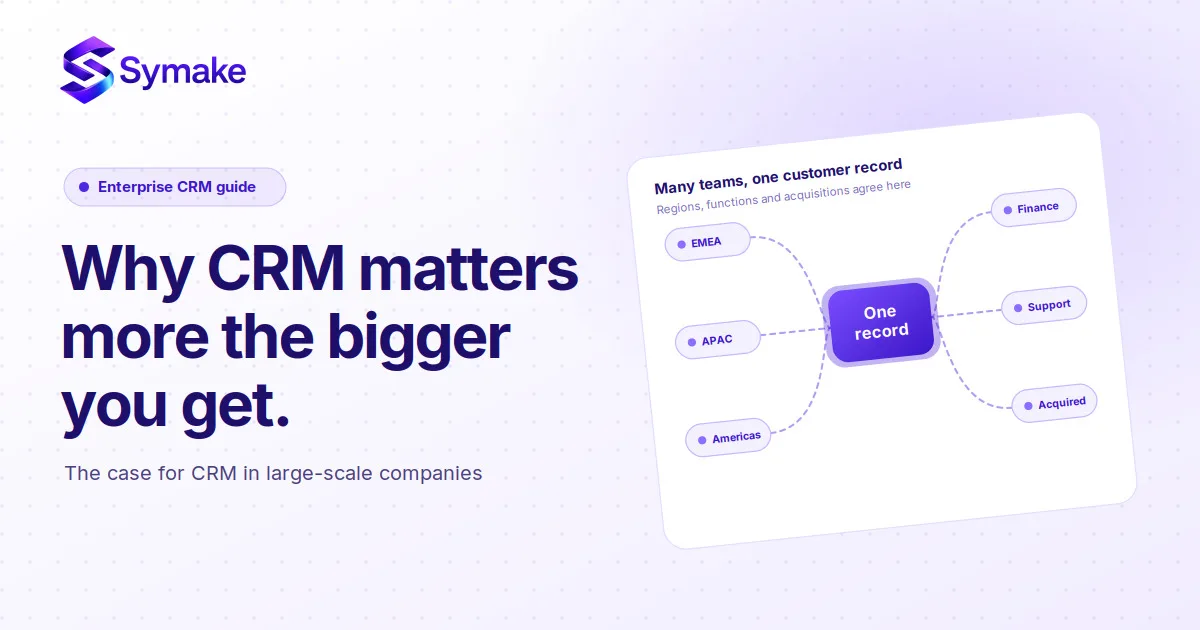
That moment is when ERP stops being an IT purchase and becomes a survival tool. Last week we looked at why CRM matters more as you grow. ERP is the other half: the back office that has to make good on everything the front office promised. This is the case for it, as I'd make it across a table.
First, the numbers (and how much to trust them)
ERP statistics are messy, because every analyst defines "ERP" differently. I'll flag that as I go.
- Gartner put the global ERP software market at about $66 billion in 2024, up 11.3% from the year before. A broader definition that includes HR and finance applications (Apps Run The World) puts it at around $132 billion. Both are "right"; they measure different things.
- Among large companies, ERP is close to standard. Eurostat's 2025 data shows 89.4% of large German companies (250+ employees) use ERP, against 67.7% of medium-sized and 37.5% of small ones. The pattern is the useful part: the bigger the company, the closer to universal.
- In Panorama Consulting's 2026 survey, 30% of ERP projects went over budget and nearly a quarter ran past their planned timeline. The median project took 9 months. Their earlier, more enterprise-heavy 2023 sample had 47% over budget, so the picture depends on who you ask.
- Panorama also found 77.4% of companies realised the benefit of removing silos in 2026, up from 55.2% the year before.
- The sobering ones: Gartner forecasts that over 70% of recently implemented ERP initiatives will not fully meet their business case goals by 2027, and McKinsey (2025) puts it at nearly 70% of ERP transformations failing to realise their full potential. Both point at organisational causes more than technology.
Read those together. Large companies almost all have ERP. Most don't get everything they hoped for from it. So the live question isn't "should we have ERP", it's "why does so much of it underdeliver, and what makes the difference". That's the thread through the rest of this post.
A caution: "went over budget," "didn't meet goals" and "failed" are different measures, and most benefit figures in these surveys are self-reported. Use them for direction, not for a business case.
Why ERP becomes more important as you grow
1. One set of numbers the whole company can sign
In a small business, the owner knows the numbers. In a large one, the numbers are assembled: from each plant, each entity, each currency, each accounting practice that grew up locally.
ERP is where those get unified. One chart of accounts. One definition of cost. Multi-company, multi-currency and intercompany transactions handled by the system rather than by a finance analyst with a macro-heavy workbook. The practical result is the month-end close. Companies without ERP close in weeks and apologise for the delay. Companies with a well-run one close in days, and the numbers don't change after they're published.
For a group with lenders, investors or a listing, that reliability is not cosmetic. It's what lets the board make a decision on Thursday based on figures that were true on Wednesday.
2. Inventory, procurement and production stop being guesswork
This is where the money usually hides. A large company has capital tied up in stock it may not need and shortages of stock it urgently does. Each plant orders for itself. Purchasing doesn't see what the plant next door has in surplus. Production plans assume materials that haven't arrived.
ERP connects it: demand, stock, purchase orders, supplier lead times, production schedules and costing in one flow. You can see what's on hand across every location, what's on order, what's committed, and what will run out when. Even modest improvements here move working capital, which is the one number every CFO watches.
3. Controls and compliance are built into the process
Large organisations have rules about who can approve a purchase, at what value, who can change a vendor's bank details, and what must be recorded for audit. Written into a policy document, those rules are suggestions. Built into the workflow, they're enforced.
ERP gives you approval hierarchies, segregation of duties, audit trails and consistent tax handling. In India, that includes GST invoicing and e-invoicing workflows that change often enough that doing them manually is a standing risk. We covered the wider principle in how integrated systems eliminate manual compliance risks. In large companies, ERP is usually where that discipline lives.
4. It lets you standardise without losing local control
Every acquisition, every new plant, every new region arrives with its own way of doing things. Without a shared platform, you run N businesses held together by email.
ERP gives you a template. The core processes (order-to-cash, procure-to-pay, record-to-report) are the same everywhere, which makes reporting comparable, onboarding faster and benchmarking possible. Local variation, where there is a real legal or market reason for it, sits on top of a shared core instead of replacing it. Opening a new site becomes "deploy the template" instead of "invent the process again".
5. It connects to the front office, which is where the value shows up
The customer experience isn't made by sales alone. It's made by whether the order ships on the promised date, the invoice is right, and the account team knows the customer is 60 days overdue before the renewal call.
That's why ERP and CRM belong together. We made that case in How CRM and ERP Together Improve Business Visibility, and the CRM post from last week covers the front-office side. For a large company, the integration between them is where visibility stops being a slogan.
6. It's the data foundation for automation and AI
AI in ERP is moving quickly. Gartner forecasts that by 2027, 62% of cloud ERP spending will go to AI-enabled solutions, up from 14% in 2024. That is a forecast, not an outcome, and one survey of SAP users in DACH found 51% hadn't yet realised any AI use case. Reality is behind the marketing.
But the direction is clear, and it has a precondition: AI can only automate, predict or reconcile well on data that's consistent. Duplicate vendors, inconsistent item codes and three versions of a cost centre make an agent faster at being wrong. In Odoo 20, for example, the headline features are agentic: a native MCP server, natural-language search across the database and AI assistants that act on records. We went through that in our Odoo 20 upgrade guide. Clean ERP data is what makes any of it safe to switch on.
What "important" looks like, versus what it usually looks like
A pattern we see often in large organisations, described generally.
A company implements an ERP. Go-live is declared a success. Eighteen months later, the plants keep side spreadsheets "because the system is slow", purchasing places orders by email and enters them after the fact, finance posts manual journals to fix what the sub-ledgers got wrong, and the month-end close still takes three weeks. The ERP exists. The company runs on workarounds around it.
Now compare a company where the ERP is genuinely the spine. Master data (items, vendors, customers, cost centres) has an owner and a clean-up routine. Processes are standardised across sites, with deviations approved centrally. Users are measured on what's in the system. The close is a routine, not an event.
The software in those two companies may be identical. What differs is ownership, standards and discipline. That is also what the failure statistics above are really measuring.
Where big ERP rollouts quietly go wrong
If you're a large company, these are the traps I'd watch for.
Treating it as a technology project. Panorama's data and McKinsey's both point to organisational causes. If finance, operations, procurement and the plants aren't driving the design, you build a system that is technically right and operationally ignored.
Customising to avoid change. The most expensive ERPs are the ones bent to match every legacy habit. Each customisation costs you at build time, at test time and again at every upgrade. Change the process first. Customise only where the process is a genuine competitive advantage.
Migrating bad master data. Duplicate vendors, dead items and inconsistent units move cleanly into a new system and keep misbehaving there. Clean before you move, with a named owner for each data domain.
Big-bang go-live with no fallback. Switching every plant on the same weekend maximises risk. A phased rollout, starting with one site or one process, lets you learn on something survivable.
Underinvesting in training and change management. The budget goes on licences and consultants; the people who must use the system get a two-hour session. Adoption, not configuration, decides the outcome.
Ignoring the cost of staying put. Every quarter on disconnected systems has a price, even if it never appears on an invoice. We broke that down in the true cost of not using a CRM or ERP. And once a system is in, integration with the rest of the stack is where much of the remaining value sits.
Which ERP, and where does Odoo fit?
I'll be straight, because you'd want me to be.
For the very largest global groups with deeply complex, multi-country, multi-industry operations, the usual shortlist includes SAP, Oracle and Microsoft Dynamics, and a serious evaluation should include them.
For large and fast-growing operations businesses, particularly in manufacturing, trading, distribution and services, Odoo is a credible option, especially where you want ERP and CRM in one platform, a modern interface, and costs that don't scale with every user. It rewards disciplined implementation, and it suffers if you customise it into a corner. Our comparison of Salesforce and Odoo by business size and budget is a good starting point.
Whichever you shortlist, the principle holds: the platform matters less than the decisions around it. Who owns the master data, how standard the processes are, how you phase the rollout, and who is accountable for adoption.
Conclusion: At scale, ERP is how the company keeps its promises
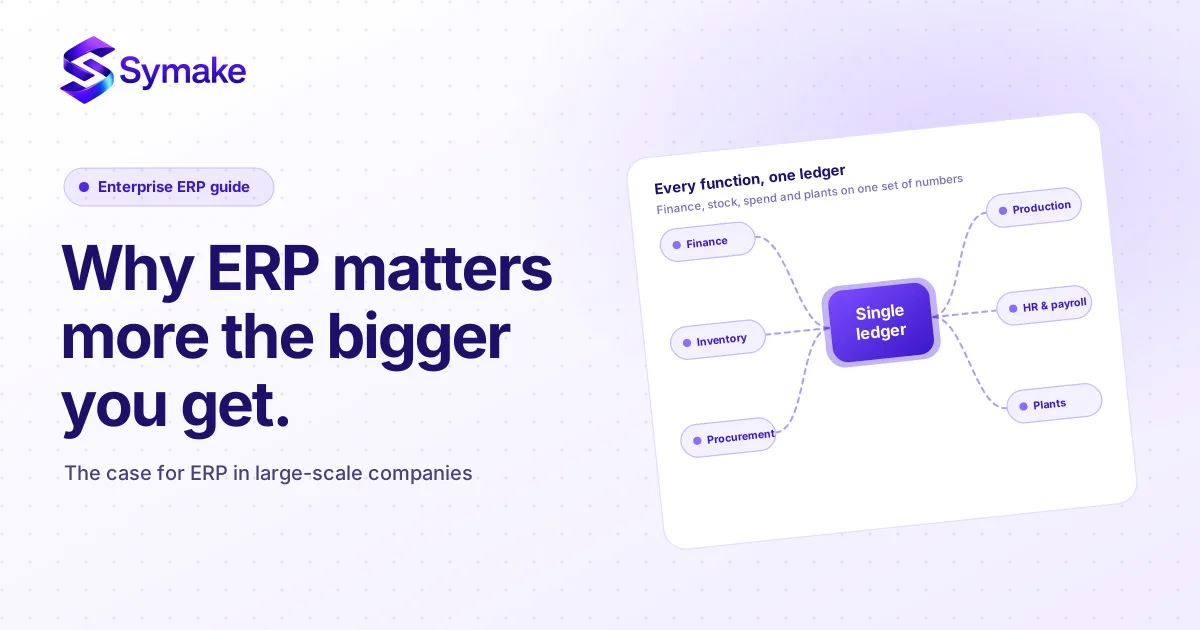
A small company can keep its numbers in someone's head. A large one can't, because the work is spread across too many people, sites and entities for any single person to hold it all. ERP is how that spread-out business still behaves like one company: one ledger, one view of stock and spend, one set of controls.
That's why the case for ERP gets stronger as you grow, not weaker. And it's why the projects that disappoint rarely fail on features. They fail on ownership, data and change.
At Symake, we implement and upgrade Odoo for growing and large businesses, and we spend as much time on master data, process standards and rollout phasing as on configuration, because that's where the return is decided. If you're planning an ERP rollout, or you own one that's still running on workarounds, talk to our team. We'll start with an honest look at what you have before recommending anything.
People Also Ask (FAQs)
Why is ERP important for large companies?
Large companies spread work across many sites, entities, currencies and teams, so no single person can see the whole picture. ERP provides one set of financial and operational data: a unified ledger, a shared view of inventory and spend, built-in approval controls and audit trails, and a consistent base for reporting and AI. Its value grows with the number of moving parts.
What is the difference between ERP for small and large businesses?
Small businesses mostly need accounting, invoicing and basic inventory. Large enterprises also need multi-company and intercompany accounting, multi-currency and tax handling, advanced procurement and production planning, role-based approvals and segregation of duties, audit trails, and standard processes that can be rolled out across plants and regions.
How many large companies use ERP?
Almost all of them. Eurostat's 2025 data shows 89.4% of large German companies (250+ employees) use ERP, compared with 67.7% of medium-sized and 37.5% of small ones. Definitions vary by country and survey, but the pattern is consistent: the larger the company, the more standard ERP is.
Why do so many ERP implementations fail?
Mostly for organisational reasons, not technical ones. Gartner forecasts that over 70% of recent ERP initiatives won't fully meet their business case by 2027, and McKinsey estimates nearly 70% of ERP transformations fail to realise their full potential. Common causes are unclear ownership, excessive customisation, poor master data, big-bang go-lives and weak change management. Note that "over budget", "delayed" and "failed" are different measures.
How long does an enterprise ERP implementation take?
Panorama Consulting's 2026 survey reported a median of about 9 months, down from 15.5 months in its 2024 report, though large, multi-country programmes routinely take longer. Phased rollouts that start with one site or one process usually go more smoothly than a single big-bang go-live.
What is the difference between ERP and CRM?
CRM manages the front office: leads, sales pipeline, customer service and relationships. ERP manages the back office: finance, inventory, procurement, production and HR. They solve different problems and work best connected, so a deal closed in the CRM flows into fulfilment and invoicing in the ERP without re-keying.
Is Odoo suitable for large companies?
For large and fast-growing operations-heavy businesses in manufacturing, trading, distribution and services, yes, with disciplined implementation and limited customisation. For the largest multinational groups with highly complex global requirements, SAP, Oracle and Microsoft Dynamics are also standard parts of the evaluation. A short process assessment is the most reliable way to decide.