Your Best Real Estate Leads Go Cold After the Site Visit. Here's the CRM Setup That Stops It
Builders and brokers lose buyers between enquiry and booking. A practical real estate CRM setup in Salesforce or Odoo, with what Tata Realty and L&T Realty report.
Real estate CRM setup for builders and brokers
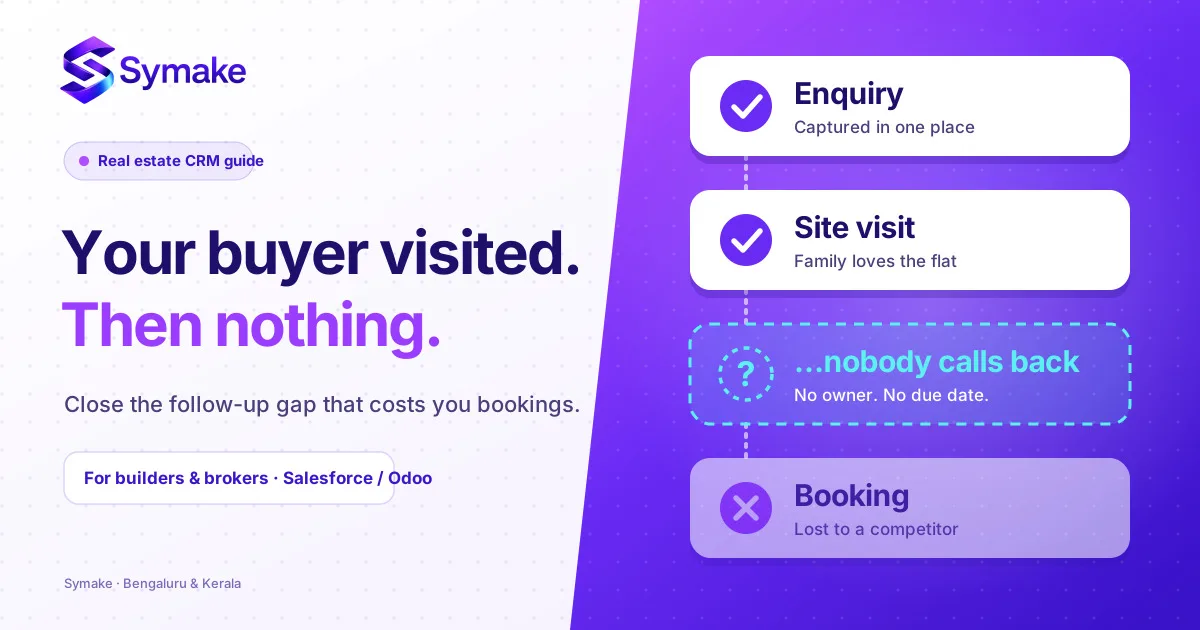
A few months ago I sat in a sales review at a developer I'll call by no name, because they'd rather I didn't. The sales head had a spreadsheet open. Forty families had visited the show flat the previous month. Eleven had been called back within two days. Nine had been called back at all after a week. And three of the people who had been told "we'll get back to you with the final price" were, by then, sitting in a competitor's sales office.
Nobody in that room was lazy. The problem was simpler and more annoying: after the site visit, nobody clearly owned the next step.
If you build, broker or manage property, I'd bet you recognise this. The enquiry comes in, someone calls, the family visits, everyone feels good, and then the trail goes quiet. In my experience that gap, between the visit and the booking, is where most of the money in real estate sales leaks out. It's also where a CRM earns its keep or doesn't.
What the big developers say they gained
Two large Indian developers have published numbers about this, and they're worth reading with the right amount of salt.
Tata Realty and Infrastructure announced in May that it had put Salesforce's marketing, sales and service tools on a single customer view. In the joint press release, Tata Realty reports that its first response to a buyer enquiry fell from days to eight hours, that lead qualification improved by 30%, and that conversion rose by 10%. It also says qualification now runs around the clock across WhatsApp, SMS and email.
L&T Realty, in a Salesforce customer case study, describes moving from paper forms and fragmented systems to a connected setup, and reports an 80% reduction in lead response time (typically within an hour now) and agents handling about 20% more calls.
Now the salt. Both are vendor-published. Neither gives baselines, sample sizes or how the results were measured, and the L&T case study has no visible date. I'm not saying the numbers are wrong. I'm saying they're what the companies tell their customers, so treat them as a direction of travel, not a promise you'll get the same. What I find more convincing than the percentages is what both stories have in common: they started by getting enquiries into one place and making response time visible. That's unglamorous, and it works at any size.
Where leads actually leak
Think of your buyer's journey as a pipe with joints. I see the same leaky joints again and again.
The first is capture. Enquiries arrive from portals, ads, walk-ins, channel partners, WhatsApp, a hoarding's phone number and a cousin's reference. If those land in six places, you cannot know your real lead count, let alone follow up on it. A lead that sits in someone's personal phone is, for practical purposes, a lead you don't have.
The second is the first response. The Tata Realty number is days to eight hours. If your own number is "whenever the telecaller gets to it", that's the first thing to measure, because a buyer who enquires on three projects will talk to whoever answers first.
The third, and the one I opened with, is after the site visit. The visit is the high point of interest. The next step is usually "the sales executive will send the cost sheet", and that sentence has no due date, no owner and no reminder.
The fourth is the broker channel. If you sell through channel partners, you need to know which broker brought which buyer, who is working them, and what commission is owed. Disputes here damage relationships you spent years building.
The fifth is booking to handover. Once the booking amount is paid, the buyer's relationship with you shifts from sales to finance and construction. Payment schedules, demand letters, receipts and snag lists sit with different teams, and the buyer, who is making the biggest purchase of their life, hears from three different people with three different answers.
The setup I'd build
I'll describe this tool-agnostically and then say where Salesforce and Odoo each fit.
One front door for every lead. Every source feeds one lead record, with the source tagged. WhatsApp enquiries are logged, not left in a phone. Duplicate detection runs on phone number, because the same buyer will enquire through a portal, a broker and a hoarding.
A response clock. Each new lead gets an owner automatically (by project, language or round-robin) and a timer. If it isn't touched within your target, say 30 minutes in working hours, it escalates to the team lead. Pick a target you can actually hit, then tighten it.
Stages that mean something. Mine usually run: enquiry, qualified (budget, timeline, financing checked), site visit scheduled, site visit done, negotiation, booking, agreement, registration. The one that matters is "site visit done", because entering that stage creates the next task automatically. The cost sheet, the follow-up call within 48 hours and the re-visit invitation all become tasks with owners and due dates.
Why-we-lost, captured. When a buyer drops, the system should demand a reason from a short list: price, location, possession date, loan rejected, bought elsewhere. After a quarter you'll know, with evidence, whether you have a pricing problem or a follow-up problem. Most teams assume it's pricing. In the setups I've seen, a surprising share is follow-up.
Brokers as first-class citizens. Give channel partners their own record, tie each lead to a partner, and track the commission from booking through to payout. If you want partners to log leads themselves, a simple portal does it.
A single timeline after booking. Payment schedule, receipts, demand letters, queries and snags are visible on one buyer record, so whoever picks up the phone sees the full picture.
Salesforce or Odoo? An honest answer
This is the question I get most, and the honest answer is "it depends on what your pain is".
Salesforce is strongest when the pain is on the sales and customer-experience side, and you have enough volume and complexity to justify it: many projects, big marketing spend, a large sales team, a call centre, and a need for deep reporting and AI-assisted qualification of the kind Tata Realty describes. It integrates with other systems well, but it's a CRM platform first. The cost is higher, and since this autumn the editions and pricing have changed, which we covered in our look at the new Salesforce editions.
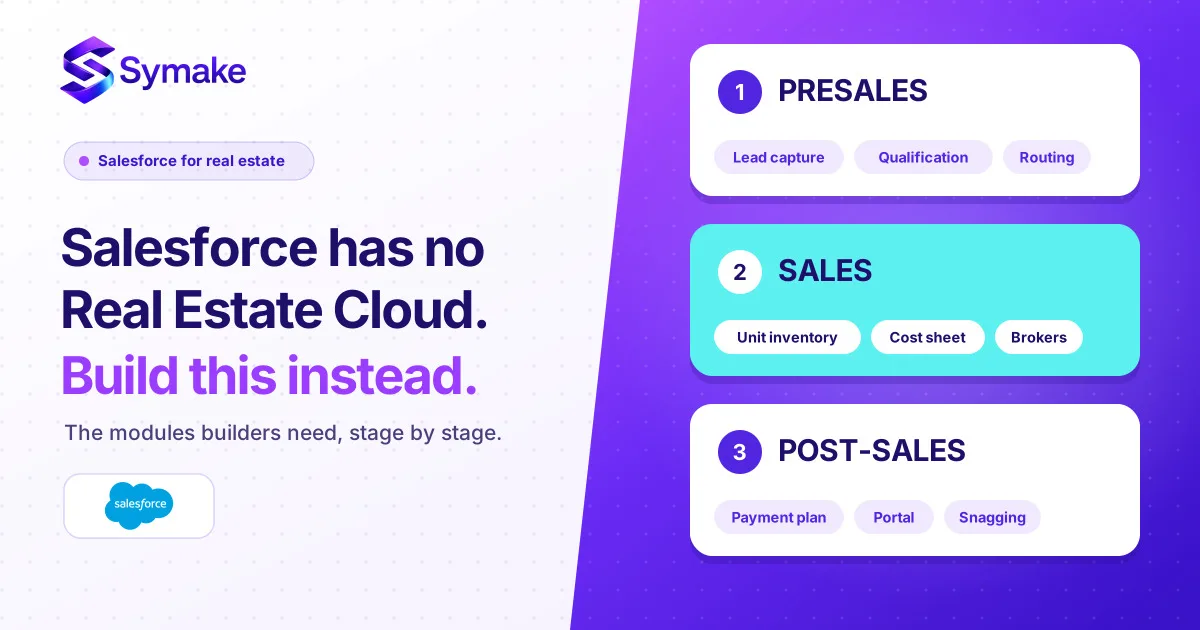
Odoo is strongest when the pain runs across sales, accounts and operations: you want the lead, the booking, the invoice and the payment schedule in one system without stitching tools together. Odoo's app store lists several real estate and property management modules, but these are built by third-party developers, so quality and fit vary, and I'd treat them as a starting point to evaluate and adapt, not as a finished product. Whatever you pick, the customisation for things like payment-linked-to-construction-stage schedules and broker commissions is where the work lies.
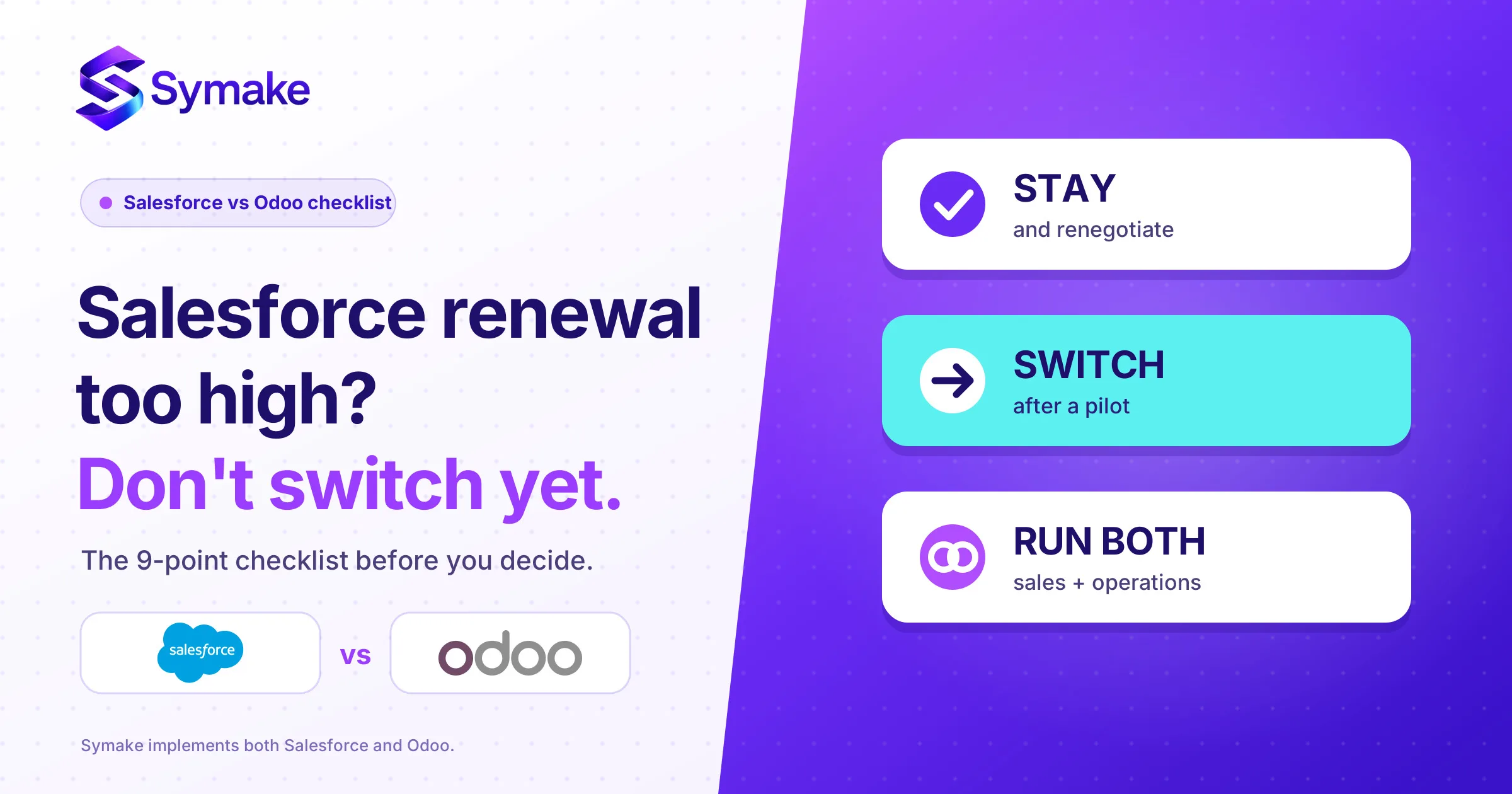
For a small or mid-sized builder or a brokerage, I usually find Odoo's all-in-one scope more practical. For a large developer with heavy marketing and a big sales organisation, Salesforce's depth is easier to justify. And for some, a mix works: Salesforce in front for sales, Odoo behind for finance and operations. If you're weighing a move either way, our switching checklist and the Salesforce vs. Odoo comparison will help.
What to do in the next 30 days
You don't need a big programme to start. Here's the version I'd actually run.
In week one, count your leads honestly. Gather every source, de-duplicate on phone number and see how many real enquiries you had last month. That number alone is often a surprise.
In week two, measure your response time and your after-visit follow-up on a sample of fifty leads. How long did the first call take? What share of site visitors were contacted again within 48 hours?
In week three, define your stages and the automatic task that follows "site visit done". You can test this on paper or a shared sheet before touching software.
In week four, pick one project to pilot on a CRM: one team, one set of leads, one clear measure, such as the share of visitors followed up within 48 hours. Compare it to the sample you took in week two.
If the pilot moves the number, you have your business case. If it doesn't, you've learned something cheaply. Either way you'll know more than any vendor page can tell you. And if the cost of doing nothing feels abstract, our piece on the true cost of not using a CRM or ERP puts some shape on it.
Conclusion
Real estate sales is a long, human, high-trust process, and the places it breaks are not mysterious. Leads are scattered, the first response is slow, nobody owns the step after the visit, brokers aren't tracked, and the buyer's record fragments after booking. A CRM won't fix a weak project or a wrong price, but it will stop good leads going cold for the dull reason that nobody was reminded to call.
At Symake we implement both Salesforce and Odoo, from our offices in Bengaluru and Kerala, so we'll tell you which fits your size and your pain rather than selling you the one we like. If you'd like a straight review of how your leads move today and where they stall, talk to our team.
People Also Ask (FAQs)
What is a real estate CRM?
A real estate CRM is software that captures every buyer or tenant enquiry in one place, assigns it to someone, tracks each step from enquiry to booking, and reminds the team what to do next. Good ones also track channel partners, payment schedules and after-sales requests, so the buyer's whole history sits on one record.
Why do real estate leads go cold after the site visit?
Usually because the next step has no clear owner or deadline. After a visit, the promised cost sheet or call-back depends on someone remembering. A CRM that creates a task automatically when a visit is marked done, with a due date and an escalation, closes that gap.
Which is better for real estate in India, Salesforce or Odoo?
It depends on your size and where the pain is. Salesforce suits large developers with heavy marketing, big sales teams and a need for deep reporting and AI-assisted qualification. Odoo suits builders and brokers who want sales, accounts and operations in one system at a different cost structure. A short assessment of your process is the reliable way to choose.
Are the Tata Realty and L&T Realty results typical?
Not necessarily. Tata Realty's figures (first response from days to eight hours, 10% higher conversion, 30% better lead qualification) come from a joint press release with Salesforce. L&T Realty's (80% faster lead response, about 20% more calls handled) come from a Salesforce customer case study. Both are self-reported with no baselines or methods published, so use them as a direction, not a forecast.
Can a CRM track channel partners and brokers?
Yes. You can record each partner, link every lead to the partner who brought it, and track the commission through to payout. Many teams also give partners a portal to log leads themselves, which reduces disputes about who brought which buyer.
Does Odoo have a real estate module?
Odoo's app store lists several real estate and property management modules, mostly built by third-party developers. They can be a good starting point, but check fit for your own needs, such as payment schedules linked to construction stages, and budget for customisation.
How fast should we respond to a new real estate lead?
Faster is better, but pick a target you can hit consistently. Tata Realty reports its first response fell from days to eight hours, and L&T Realty reports responding typically within an hour. For your own team, measure your current response time first, then set a target such as 30 minutes during working hours and escalate any lead that misses it.