Quick Commerce Is Rewriting FMCG Distribution. Here's What Your CRM and ERP Need to Do About It
HUL, Marico and Nestle say quick commerce is reshaping FMCG. Here is what mid-sized brands need from Salesforce or Odoo: channel packs, promo ROI, stock visibility.
FMCG quick commerce and distribution systems
If you sell fast-moving consumer goods, you have probably had this conversation in the last few months: "Quick commerce is growing, a dark-store chain wants to list us, and we are not sure our systems can keep up."
You are in good company. When India's big FMCG names reported their April to June quarter results in August, quick commerce came up on almost every call. I'll walk through what they said, because it is a useful window into what this channel actually demands, and then get to the part that matters for a mid-sized brand: what your CRM and ERP need to do about it.
What the big players said
MediaNama summarised the Q1 FY27 earnings calls in an August article. A few details stood out.
Hindustan Unilever said quick commerce is growing 40 to 50% for it and called it a long-term structural opportunity. It is designing price packs exclusively for the channel and using it to reach consumers in small towns and rural markets. On the supply side, it pointed to a distribution centre where "AI-enabled real-time visibility" supports demand sensing and delivery tracking.
Marico said quick commerce contributed more than 50% of the growth in its core business, while making up about 5% of its India business revenue (excluding digital brands). Its CEO described avoiding "cannibalistic growth" by using channel-specific pack sizes and test products. The company has invested in AI-led demand sensing and forecasting, which it says lets it run a "very thin" distributor pipeline and change prices faster.
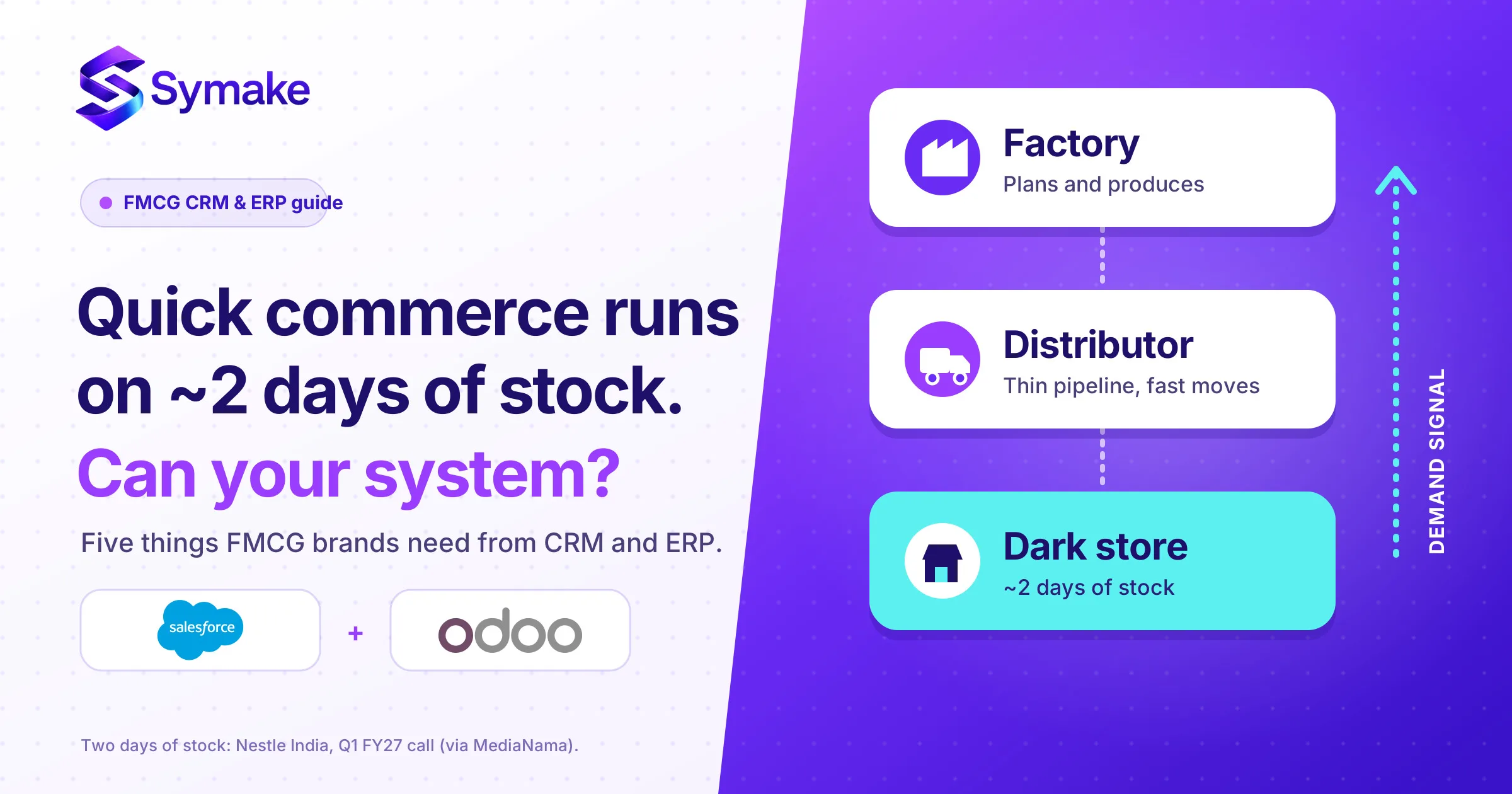
Nestle India said quick commerce is helping its premium portfolio, whose share of sales rose from 11% to 14%, and described the channel as almost a launch pad for innovation. It said quick commerce players operate close to 6,000 dark stores, and that it manages roughly two days of stock across that network through its supply chain partners. It has also moved to SAP S/4HANA and embedded machine learning and AI across its value chain.
A caution on all of this. These are management statements on earnings calls, relayed by a news site, so they are the companies' own framing. And the three are very large companies with very large budgets. What I want you to take from them is the pattern, not the percentages: new channel, channel-specific packs and prices, thin pipelines, and a heavy reliance on demand signals and stock visibility.
What that pattern asks of your systems
Strip away the brand names and each of those stories asks the same five questions of a company's systems. Here they are, in the order I'd tackle them.
1. Can you sell the same product differently by channel?
Channel-specific packs and prices are the heart of Marico's and HUL's approach. That means your system needs to handle multiple pack sizes, price lists per channel (general trade, modern trade, quick commerce, your own online store), and promotions that apply to one channel without leaking into another. If your price lists live in spreadsheets, a price mistake in one channel can undercut another within a day.
Both Odoo and Salesforce handle this in different ways. Odoo's price lists and promotion rules cover channel pricing and bundles in standard sales and inventory apps. Salesforce, through its Consumer Goods offering, is aimed at planning and executing across channels.
2. Do you know whether your promotions pay off?
Promotions eat a large share of an FMCG budget, and the usual failure is that nobody can say which ones worked. You need each promotion recorded with its cost, its dates, the channel, and the volume it moved, so that you can compare spend to uplift afterwards.
Salesforce's Consumer Goods Cloud includes Trade Promotion Management, with promotion planning, volume modelling and accrual tracking. Salesforce's page says customers see a 29% increase in promotion ROI, but that figure comes from Salesforce's own "customer success metrics" with no method given, so treat it as marketing, not a benchmark. In Odoo, promotions can be modelled with pricing rules, but dedicated trade promotion analytics usually means reporting tools or an add-on.
3. Can you see stock where it actually sits?
Nestle's "two days of stock" across a dark-store network, and Marico's "very thin" distributor pipeline, only work if you can see stock at the distributor and, ideally, at the channel partner, not just at your own warehouse.
That means capturing secondary sales (what distributors sell on to retailers) and distributor stock. Salesforce lists distributor management features for purchase orders, goods receipts and stock audits. In Odoo, the strong native part is your own inventory, including lot tracking and expiry dates with first-expired-first-out removal. Distributor and route-sales capabilities, such as van sales apps, usually come from third-party Odoo modules or integrations, so check their quality and fit before you commit.
4. And in your own warehouse, can you rotate stock by expiry?
This one is basic and it is where many FMCG companies lose money quietly. Batch and expiry tracking, with a rule that ships the oldest-expiring stock first, cuts write-offs. Odoo does this natively through lots and removal strategies. It's a good illustration of why, for a growing FMCG manufacturer, the ERP side often matters more than the CRM side.
5. Do you have demand signals, and can you act on them?
"AI-led demand sensing" is the phrase both HUL and Marico used. Underneath the AI is something dull: clean, timely sales and stock data by SKU, channel and location. A forecasting model fed with late, patchy or duplicated data gives you confident wrong numbers.
This is where I'd be most careful with a mid-sized business. Start by getting the data right: consistent SKU codes across systems, daily secondary-sales feeds from your top distributors, and a single customer and outlet master. Only then add forecasting, whether that's Salesforce's AI tooling, Odoo with an external forecasting engine (a partner article I read notes that forecasting beyond simple averages usually needs an add-on), or a purpose-built tool. We said much the same about retailers last week in our Black Friday data-readiness post: AI removes the slack that used to hide data problems.
Salesforce, Odoo, or both?
I'm asked this in every FMCG conversation, so here is my honest short version.
Salesforce tends to fit when your main pain is on the commercial side: a large field sales team, many outlets, trade promotions to plan and measure, and distributors to manage, usually in a bigger organisation. Salesforce's own consumer goods page says seven of the top ten CPG companies plan or run on it, which is a vendor claim, but the product is built for that scale and its cost reflects it.
Odoo tends to fit when you are a manufacturer or distributor who wants inventory, lots and expiry, manufacturing, purchasing, accounting and sales in one system. It's often the more practical choice for a growing brand, though you should expect third-party modules or custom work for route sales, retailer EDI and proof-of-delivery.
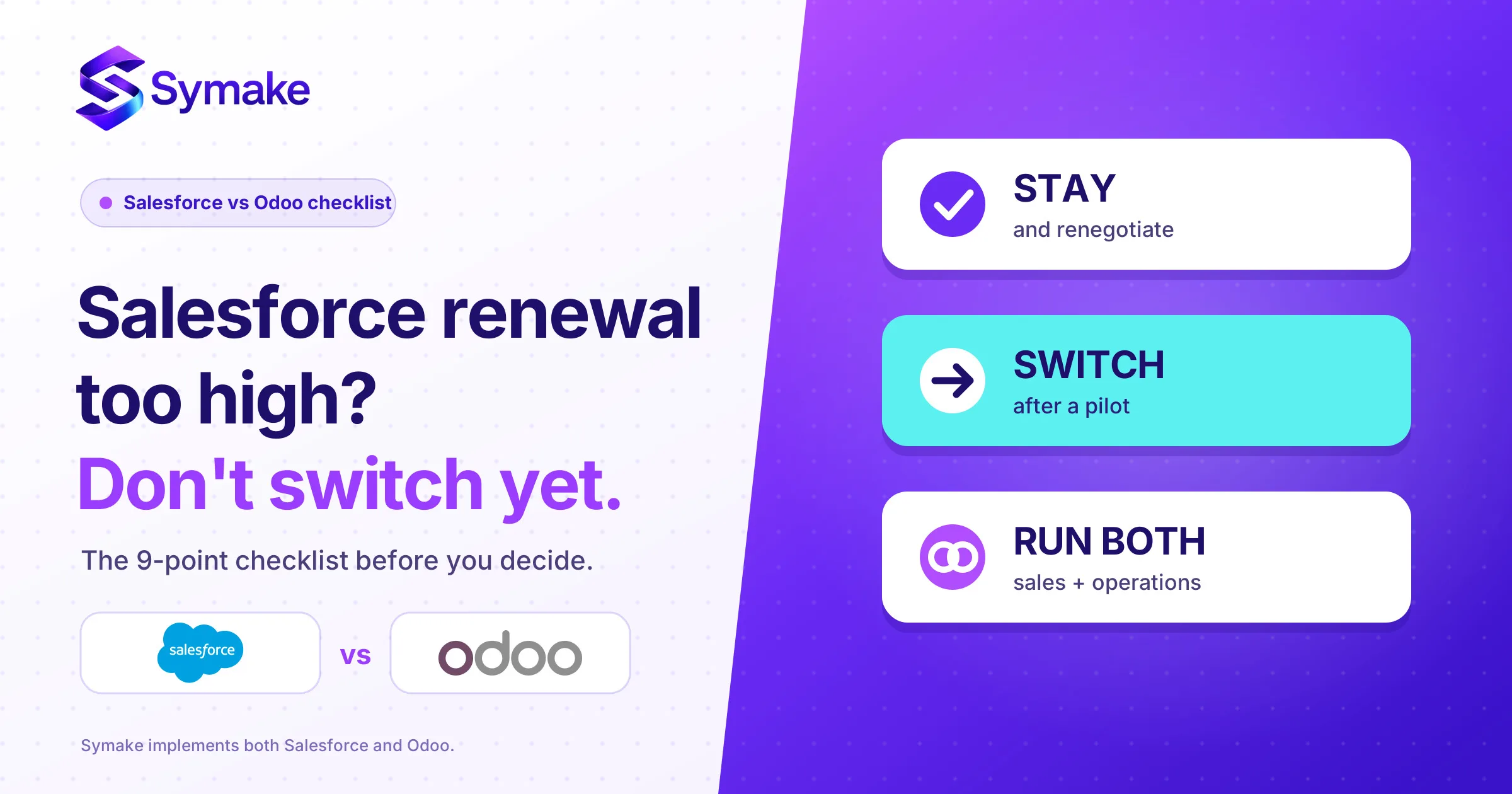
Plenty of businesses end up with both: a CRM and field-sales layer in front, and an ERP behind it. Our Salesforce vs. Odoo comparison walks through how to decide by size and budget, and our look at why ERP matters as you scale covers the wider argument.
A 90-day plan for a mid-sized FMCG business
You don't need an enormous programme. Here is the order I would suggest.
In the first month, clean your masters: SKUs, price lists by channel, outlets and distributors. It's dull and it's the foundation for everything else.
In the second month, connect the visible gaps: capture secondary sales and stock from your top ten distributors (even by a daily file upload at first), and record every promotion with its cost, dates and channel.
In the third month, build the first useful report: promotion spend versus volume by channel, and distributor stock cover by SKU. If that report changes a decision, you have found your business case for going further, including any AI forecasting.
If you're wondering what carrying on without this costs, the true cost of not using a CRM or ERP puts some shape on it.
Conclusion
Quick commerce is one channel among many, but it exposes a weakness that every FMCG business has: how fast, and how accurately, can you see what is happening to your product once it leaves your gate? The large players are answering with AI-led demand sensing and rebuilt supply chains. A mid-sized brand can answer the same question with cleaner data, a few connected systems and one good report, and then grow from there.
At Symake we implement Salesforce, Odoo and AI solutions for businesses in India and around the world. If you'd like a straight view of what your FMCG operation needs, which system fits, and what's worth building first, talk to our team.
People Also Ask (FAQs)
How is quick commerce changing FMCG?
According to Hindustan Unilever, Marico and Nestle India on their Q1 FY27 earnings calls, quick commerce is growing fast and is being served with channel-specific packs and prices, tighter distributor pipelines and AI-led demand sensing. These are company statements as reported by MediaNama, not independent measurements.
What does an FMCG company need from its CRM?
Mainly outlet and distributor records, a field-sales and retail-execution workflow, promotion tracking with cost and results, and visibility of secondary sales. Salesforce's Consumer Goods Cloud covers trade promotion management, retail execution and distributor management, and Odoo can cover parts through standard apps and add-ons.
What does an FMCG company need from its ERP?
Accurate inventory with batch and expiry tracking, first-expired-first-out picking, channel-based price lists, manufacturing and quality checks, purchasing and replenishment, and accounting. Odoo covers these in standard apps, with route sales, retailer EDI and advanced forecasting usually needing add-ons or integrations.
Is Salesforce or Odoo better for FMCG?
It depends on your size and pain. Salesforce suits larger organisations with big field teams, many outlets and trade promotion needs. Odoo suits manufacturers and distributors who want inventory, manufacturing, sales and accounting in one system. Many businesses use both, with the CRM in front and the ERP behind.
What is trade promotion management?
It is the planning, tracking and measuring of promotions run with retailers and distributors, including budgets, dates, expected and actual volume, and the cost of discounts or incentives. The aim is to know which promotions earned their cost.
How can AI help with FMCG demand forecasting?
AI can combine sales, stock, promotion and seasonal data to anticipate demand by SKU, channel and location, which lets a company hold less stock and react faster. It depends on clean, timely data, so fix SKU codes, distributor data feeds and outlet records before adding a forecasting tool.
How do we start improving FMCG systems without a big project?
Clean your product, price and outlet data first, then capture secondary sales and stock from your top distributors, record every promotion with cost and result, and build one report that compares promotion spend with volume by channel. Use what that report shows to decide the next step.