Introduction: Growing Businesses Don't Just Hire More People, They Build Better Systems
There is a version of business growth that feels like running faster on a treadmill. Revenue climbs. Headcount climbs with it. Complexity multiplies. And somewhere around ₹30–50 crore in annual revenue, the founder realises they are working harder than ever, but not getting meaningfully ahead.
Then there is a different version. The version where revenue climbs, but the operational load does not scale at the same rate, because the business has been built on systems that carry the weight that people used to carry.
The ability to scale business with systems is the defining capability separating businesses that plateau from those that compound. And the research is unambiguous about how large this gap has become.
The global CRM market alone is projected to reach $126.17 billion in 2026, growing at 12.4% annually toward $320.99 billion by 2034 (Fortune Business Insights, 2025). Businesses using CRM software experience a 300% increase in conversion rates. Meanwhile, 91% of companies with 10 or more employees now use a CRM system, making it one of the most widely adopted categories in enterprise software. Companies executing what Bain & Company calls "commercial excellence" through integrated systems deliver 2–3x the revenue growth of their peers.
This article is not a theoretical framework. It is a case-based examination of how real companies, across manufacturing, distribution, financial services, and professional services, have used systems to break through the plateaus that people-heavy, process-light businesses always hit.
📊 The Research Foundation: Why Systems Drive Scale
Before the cases, here is what the data says about systems and business growth:
Research Finding | Data Point | Source |
CRM impact on conversion rates | 300% increase | |
Companies using CRM that exceed sales goals | 86% more likely | |
Businesses using generative AI in CRM that exceed goals | 83% more likely | |
Manufacturing companies reporting sales boost from CRM | 21–30% boost | |
Healthcare patient satisfaction increase via CRM | 53% improvement | |
Companies with commercial excellence vs peers | 2–3x revenue growth | Bain & Company |
CRM forecast accuracy improvement | 42% | Salesforce, 2026 |
Sales revenue increase from CRM | 29% average | Salesforce / Nutshell, 2026 |
AI-integrated CRM adoption by 2026 | 81% of organizations | |
Companies that fail to fully implement CRM | Over 60% | |
The standout finding: Less than 40% of companies fully implement CRM systems, and 42% cite lack of training or CRM experts as the biggest barrier, with strategy and deployment issues affecting another 40%. The advantage goes not to businesses that buy the best system, but to those that implement it completely.
Why Systems Are the Only Scalable Asset a Business Has
Every other resource a business depends on has a ceiling.
People hit capacity, they get overwhelmed, leave, and take institutional knowledge with them. Capital gets consumed, every hire and every process adds to the cost base. The founder's attention is the most finite resource of all.
Systems, however, compound. A well-configured CRM pipeline does not tire. An automated follow-up sequence does not forget. A real-time financial dashboard does not require three days and a spreadsheet to produce.
The analogy is infrastructure. A road does not need to hire more employees to handle more cars. It was built once and carries increasing volume over time. Business systems work the same way, the setup cost is front-loaded, and the returns compound with every additional lead, customer, and transaction that passes through.
According to Gartner's 2026 Planning Guide for CRM and ERP Applications, generative AI is rapidly changing the enterprise application landscape, and businesses that enhance their data strategy and integration capabilities in 2026 will be best positioned to optimise licensing, reduce costs, and outperform peers. As businesses grow, CRM software scales to handle larger customer bases and more complex workflows, integrating with ERP, marketing automation, and payment platforms to create a fully connected ecosystem.
The question is not whether to build on systems. It is what those systems look like, in which order they get built, and what mistakes to avoid along the way.
Case 1: The Distribution Company That Outgrew Its WhatsApp Pipeline
The Situation
A mid-size FMCG distribution company in Western India with ₹75 crore in annual revenue and a team of 18 salespeople. Their pipeline lived across six reps' personal WhatsApp accounts, three shared Excel files, and a set of handwritten order books that sat in a drawer.
The company was growing at 22% annually, but the founder could not see that number in real time. Every month-end became a three-day exercise in chasing updates, reconciling versions, and producing a revenue number that was already 30 days stale by the time leadership saw it.
The breaking point: The company's best salesperson resigned in November and took his entire client list with him. Nobody had a record of the accounts he managed, the deals in progress, or the contact history for any of his customers. It took three months and ₹40 lakhs in estimated lost revenue to recover.
The System Intervention
The company implemented Salesforce Sales Cloud with a 45-day go-live target. The specific configurations built were:
- Lead-to-order pipeline with defined stages, mandatory fields at each stage, and automatic advancement triggers
- Account and contact records centralised so no customer relationship could exist only in one person's phone
- Automated follow-up sequences triggered when a deal sat in the same stage for more than 7 days without activity
- Real-time pipeline dashboard accessible to leadership on mobile, updated continuously
The Outcome (90 Days Post-Implementation)
- Pipeline visibility increased from "best guess" to live, accurate reporting within 60 seconds
- Lead response time dropped from an average of 2.1 days to under 4 hours
- Sales forecast accuracy improved by 38% in the first full quarter, consistent with Salesforce's reported 42% average improvement across CRM implementations
- When a second salesperson left 4 months later, the handover was complete in 45 minutes, every account, contact, deal, and note was in the system
The lesson: Scaling a distribution business is not about adding more salespeople. It is about ensuring that every customer relationship, every deal, and every follow-up belongs to the system, not to an individual.
📖 If your sales pipeline is still living in spreadsheets or WhatsApp, the first thing to fix is not the CRM, it is the automation layer on top of it. Read our guide on What to Automate First for Maximum Business ROI before selecting or configuring any system.
Case 2: The Manufacturing Company That Fixed Its Inventory Blindness
The Situation
A precision components manufacturer in Pune with ₹120 crore in revenue and 200+ SKUs across three production lines. Their inventory management ran on a legacy ERP system that hadn't been updated in eight years and was integrated with nothing, not sales, not finance, not logistics.
The result was a familiar pattern: sales would commit to delivery timelines without visibility into production capacity. Production would manufacture based on last month's demand signals. Finance would discover the discrepancy only when customer complaints hit accounts receivable.
The breaking point: A ₹3 crore order from their largest customer was delivered four weeks late because the sales team committed to a deadline without knowing that a key raw material was in shortage. The customer renegotiated a 15% price reduction as penalty, and began exploring alternate suppliers.
The System Intervention
Rather than replacing the legacy ERP immediately, the company built an integration layer connecting their existing ERP to Salesforce, with three specific workflows:
- Real-time inventory visibility in the sales interface — every sales rep could see current stock levels, pending production orders, and lead times before making any commitment
- Automatic capacity checks — a quote could not be converted to a confirmed order unless the system had verified manufacturing availability for the requested delivery window
- Supplier lead-time alerts — automated notifications to procurement when a raw material fell below the threshold that would impact committed delivery dates
According to Gartner Digital Markets' CRM Buyer Insights Report, manufacturers use CRM specifically to manage distributor relationships, track B2B sales, monitor after-sales service, and integrate with ERP systems, and their priorities differ from other sectors because they focus on bulk orders, long-term contracts, and supply chain integration.
The Outcome (6 Months Post-Implementation)
- Late delivery incidents dropped by 67% in the first two quarters
- On-time delivery rate moved from 71% to 94%
- Sales reps reported making delivery commitments with confidence for the first time
- The largest customer, seeing the reliability improvement, expanded order volume by 35% in the following year
The lesson: SLT Creative's research confirms manufacturing companies using CRM report a 21–30% boost in sales from more focused campaigns and better operational alignment. For manufacturers, that alignment begins with connecting sales commitments to real-time inventory and production data.
Case 3: The Professional Services Firm That Automated Its Revenue Engine
The Situation
A 45-person management consulting and IT services firm in Bengaluru with ₹18 crore in annual revenue. Their business development process was entirely founder-led, three partners managed all client relationships personally, and every proposal, follow-up, and renewal conversation happened through those three individuals.
This created a classic professional services bottleneck: the firm could not scale beyond the attention bandwidth of three people. Junior business development hires were underutilised because there was no system defining what they should do, when, and with which prospects.
The breaking point: The firm lost three renewal contracts in the same quarter, not because clients were dissatisfied, but because nobody had proactively reached out 90 days before renewal. The partners found out the contracts had lapsed when invoices went unpaid.
The System Intervention
HubSpot CRM was implemented with a specific focus on two workflows:
Workflow 1 — New Business Pipeline:
- All inbound enquiries automatically routed to HubSpot with source tagging
- Junior BD staff assigned specific leads with a scripted 5-touch sequence
- Partners notified only when a deal reached proposal stage — protecting their time while junior staff moved leads forward systematically
Workflow 2 — Renewal and Retention:
- All active contracts entered with end dates
- Automatic alerts triggered at 120, 90, and 60 days before renewal
- A relationship check-in sequence dispatched at the 90-day mark
- Upsell conversation triggered at the 60-day mark based on the client's current service tier
The Outcome (12 Months Post-Implementation)
- Renewal rate improved from 68% to 89% — a direct revenue retention impact of ₹2.8 crore
- Junior BD staff closed their first independent deals within 3 months using the system's guided sequences
- Partner time spent on new business development dropped by 40% while pipeline value grew by 55%
- The firm crossed ₹28 crore in revenue the following year without adding a single senior BD hire
The lesson: According to Wave Connect's 2026 CRM statistics, 82% of organisations rely on CRM for sales reporting and automation, and businesses using CRM software experience a 300% increase in conversion rates. For professional services firms, this leverage comes from systematising the process so junior staff can execute at a senior standard, consistently, without supervision.
Case 4: The Financial Services Company That Built Real-Time Leadership Clarity
The Situation
A financial advisory and wealth management firm in Mumbai with 12 advisors and ₹22 crore in AUM-linked revenue. Their three directors spent the first week of every month in "number archaeology", digging through email threads, advisor spreadsheets, and bank statements to produce a management report that was already stale by the time it circulated.
Decisions about hiring, service expansion, and advisor capacity were being made on month-old data — and the firm's rapid growth made each decision increasingly consequential.
The breaking point: The firm hired two additional advisors based on a pipeline forecast that turned out to be overstated by 40%. The new hires were underutilised for six months, at a cost of ₹28 lakhs in salary and onboarding expense against revenue that hadn't yet materialised.
The System Intervention
Salesforce Financial Services Cloud was implemented with specific configurations:
- Client portfolio tracking integrated with the firm's portfolio management software — real-time visibility into each client's holdings and advisory needs
- AUM milestone triggers — automated tasks when a client's portfolio crossed a threshold warranting a review call or upsell conversation
- Revenue forecasting dashboard pulling from committed client relationships, expected advisory fees, and pipeline maturity — updated daily without manual input
- Advisor capacity tracking showing booked vs. available capacity for each advisor, preventing over-hiring and under-utilisation simultaneously
📖 The problem this firm solved — not having real-time visibility into what their business was actually doing — is one of the most common and most expensive problems facing CEOs and founders today. Read our deep-dive on CEO Business Visibility: How Smart Systems Fix It for the full research-backed breakdown of this challenge.
The Outcome (90 Days Post-Implementation)
- Management reporting time dropped from 5 working days to under 90 minutes
- Revenue forecast variance reduced from 40% to 11% within two quarters — moving toward the 42% forecast accuracy improvement Salesforce documents across implementations
- The firm's next hiring decision — made on system-generated capacity data — resulted in a hire who was fully booked within 45 days of joining
- Client review completion rates increased from 61% to 94% through automated reminder sequences
The lesson: DemandSage's 2026 research confirms that 84% of CRM leaders consider AI crucial for interacting with modern customers, and 41% of companies have already cut costs with AI-driven CRM systems. For financial services firms, the primary CRM value is not sales automation, it is real-time leadership visibility that enables decisions to be made on today's data, not last month's best guess.
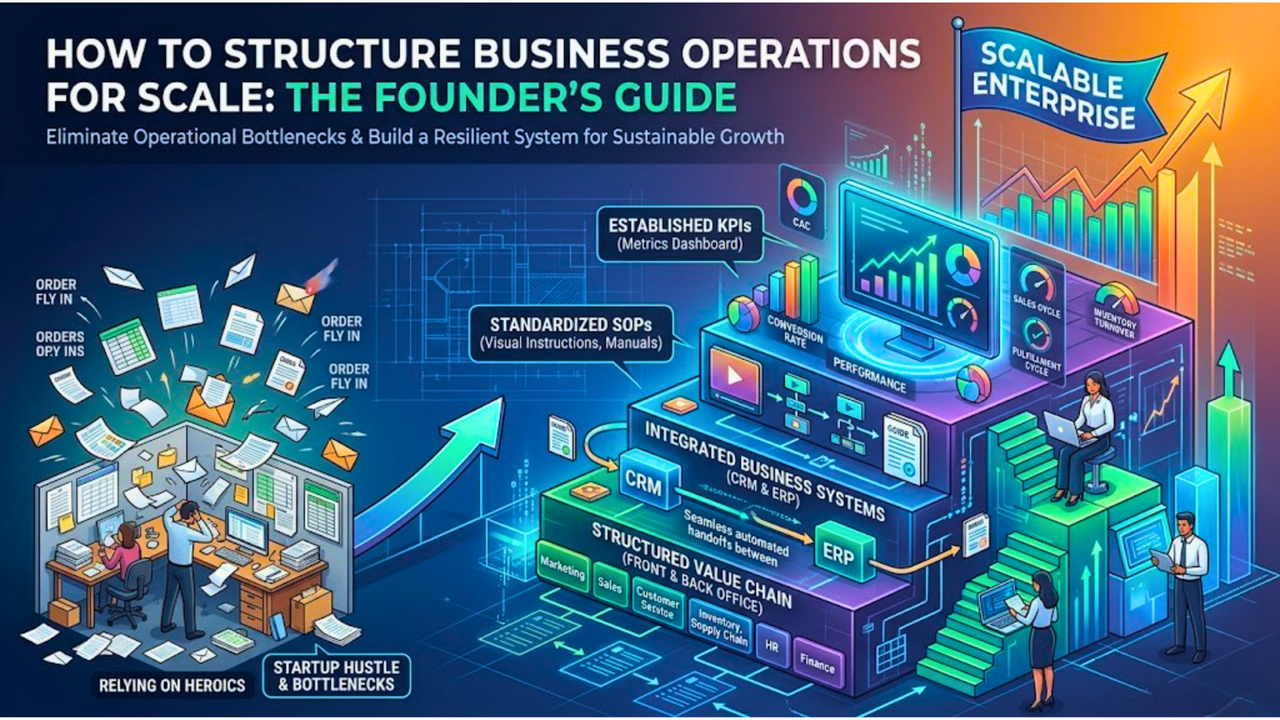
The Systems Scaling Framework: Four Stages of Maturity
Based on the patterns above and broader research, businesses that successfully scale with systems move through four identifiable stages:
Stage 1 — Reactive (Systems as Records)
The business uses a CRM or ERP to store information but not to drive behaviour. Data is entered manually after events happen. Reports are produced manually when requested. The system is a filing cabinet, not an engine.
Indicators: Pipeline is a list of deals. Revenue reports are built in Excel. Follow-ups depend on individual memory.
Stage 2 — Structured (Systems as Process)
The business uses its system to define and enforce a sales or operational process. Stages are defined. Mandatory fields prevent deals from advancing without the right information. Basic automation handles follow-up reminders.
Indicators: New hires can follow the CRM process on Day 1. Leadership can see pipeline health without asking reps. Deals no longer disappear without explanation.
Stage 3 — Automated (Systems as Engine)
Repetitive tasks — follow-up sequences, invoice reminders, renewal alerts, performance reports — run automatically without human initiation. People are freed to focus on judgment-intensive activities.
Indicators: Lead follow-up happens faster than any human-driven system could manage. Customers receive proactive communication without a team member initiating it. Reports are live, not compiled.
📖 Moving from Stage 1 to Stage 3 requires knowing the right order to build automation. Read our complete guide on What to Automate First for Maximum Business ROI for the priority-ordered framework.
Stage 4 — Intelligent (Systems as Advisor)
The system surfaces insights proactively — flagging at-risk deals, predicting churn, scoring leads by conversion probability, and recommending next-best actions. Gartner forecasts that 40% of enterprise applications will include task-specific AI agents by year-end 2026, up from less than 5% in 2025. Businesses at Stage 4 have AI-powered systems that guide human decisions rather than just recording them.
Indicators: Leadership knows about a problem before it becomes visible in the numbers. Sales reps are told which deal to prioritise before they ask. Revenue forecasts are accurate within 10% variance.
Most growing businesses operate at Stage 1 or between Stage 1 and Stage 2. The businesses in the cases above moved from Stage 1 to Stage 3, and in some cases, toward Stage 4, within 90 to 180 days of implementation.
💡 Want to know which stage your business is at? Talk to our team — we will assess your current system maturity and show you the fastest path to Stage 3.
The Three Mistakes That Prevent Systems from Driving Scale
Mistake 1 — Buying the System, Skipping the Implementation
According to CRM.org's 2026 research, less than 40% of companies fully implement CRM systems, and 25% of businesses identify training and user adoption as their biggest implementation challenges. The system is purchased, configured at a surface level, and launched without the process design, data migration, or team training that separates a working system from an expensive database.
The fix: Define the specific workflows the system must automate before configuration begins. Measure adoption in week 1, week 4, and week 12. Treat implementation as a change management project, not an IT project.
Mistake 2 — Automating Broken Processes
Systems scale what already exists. A broken sales process with three steps missing, a follow-up rhythm that never worked, and data that nobody trusts, automating this creates faster versions of the same problems.
The fix: Map your current process before selecting a system. Identify where deals are lost, where data is unreliable, and where manual steps introduce the most error. Fix the process on paper before encoding it in software.
Mistake 3 — Siloing the System from Leadership
According to servicePath's Revenue Architecture 2026 analysis, every enterprise has invested in CRM and ERP, but between those systems, in the space where a deal gets priced, validated, margin-tested, and made audit-ready, there is often nothing but Excel. The system serves the sales team, but the CEO still produces a revenue report manually.
This is the CEO visibility problem, and it is more common and more expensive than most founders recognise. The businesses that solve it gain a structural decision-making advantage over those that don't.
📖 Read the full breakdown: CEO Business Visibility: How Smart Systems Fix It — including research showing only 2% of CFOs trust their real-time financial data and what the right system fix looks like.
The fix: Every CRM and ERP implementation should produce, as a minimum deliverable, a single leadership dashboard that answers the five questions leadership asks most often, without anyone having to compile it.
What the Best-Scaling Companies Have in Common
Across the cases above and the broader research landscape, high-growth businesses that scale successfully on systems share five characteristics:
- They treat system implementation as a business transformation project — not a software purchase. Implementation ownership sits with a senior business leader, not the IT department.
- They define success in business metrics before launch — not in features enabled. The measure of success is pipeline accuracy, follow-up rate, revenue forecast variance, or customer retention — not "we've configured 14 modules."
- They prioritise integration from Day 1 — their CRM talks to their ERP, their marketing platform, and their finance system. Data flows automatically rather than being manually transferred between islands. According to Gartner Digital Markets, scalability and integration are the defining purchase criteria for CRM buyers across every industry.
- They invest in adoption as heavily as in configuration — because 42% of businesses cite lack of training or CRM experts as their biggest barrier to CRM success, and a system nobody uses delivers no return regardless of how well it was built.
- They build incrementally — starting with the highest-ROI workflows (lead follow-up, pipeline visibility, revenue reporting) and expanding systematically rather than attempting a full digital transformation simultaneously. AI and big data adoption in CRM is projected to increase by 97% between 2025 and 2030 — businesses that build clean foundations now will be positioned to deploy that intelligence when it matters.
People Also Ask
Q: What does it mean to "scale a business with systems"?
Scaling a business with systems means building infrastructure — CRM, ERP, automation workflows, and integrated analytics — that allows revenue and customer volume to grow without requiring a proportional increase in headcount, manual effort, or founder attention. Rather than hiring a person to perform every task, a system-scaled business builds processes that execute automatically, monitor performance continuously, and surface insights proactively. Bain & Company research confirms that companies executing this approach deliver 2–3x the revenue growth of peers who rely on people-heavy, process-light operations.
Q: What is the first system a growing business should implement?
For most businesses between ₹5 crore and ₹100 crore in revenue, the first and highest-impact system is a CRM configured with automated lead follow-up and pipeline tracking. This is where the greatest revenue leakage typically occurs — and the fastest ROI is recovered. Once the CRM is operating at Stage 2 maturity (structured, with defined stages and automated follow-ups), the second priority is connecting it to the finance system to produce real-time revenue reporting. For the complete priority-ordered framework, see our guide on What to Automate First for Maximum Business ROI.
Q: How long does it take for business systems to show ROI?
Based on the cases above and broader research, the typical timeline is 30–45 days for initial operational improvements, 60–90 days for measurable sales performance improvements, and 6–12 months for strategic impact. Nearly 60% of business process automation initiatives report positive ROI within 12 months, with CRM-specific implementations often delivering measurable pipeline improvement within 90 days. The speed of ROI depends heavily on data quality, team adoption, and whether the system is built on an integrated foundation.
Q: Can a small business with fewer than 20 employees benefit from CRM and systems?
Yes — and the relative impact is often higher for smaller businesses because the baseline inefficiency is greater. 71% of small businesses have adopted CRM systems, with 65% implementing within their first five years. For a business with 10–20 employees, a CRM eliminates the dependency on individual employees for customer relationship continuity, enables founders to delegate without losing visibility, and creates the process foundation that allows headcount to scale without chaos. The professional services case above — a 45-person firm growing from ₹18 crore to ₹28 crore without senior BD hires — demonstrates this leverage at a small-business scale.
Q: What is the biggest risk of scaling a business without systems?
The biggest risk is "key person dependency" — where critical business knowledge, customer relationships, and operational processes exist in people's heads, phones, and personal files rather than in a shared system. As the distribution company case demonstrates, when that key person leaves, the business loses not just an employee but a disproportionate share of its operational knowledge and customer equity. Beyond key person risk, businesses without systems consistently underperform on forecast accuracy, customer retention, and response time — gaps that compound into significant revenue losses over 12–24 month periods.
Conclusion: The Gap Is Not Strategy — It Is Systems
Every business in this article started with good strategy, good products, and capable people. What they were missing was not ambition or market fit. It was the infrastructure to execute consistently at scale.
The businesses pulling away from their competitors in 2026 are not doing so because they have more capital or more people. They are doing so because their systems follow up on every lead, their pipelines are accurate without manual effort, their customers receive proactive service before they know they need it, and their leadership can see the whole business — in real time — from a single dashboard.
The CRM market's growth to $126.17 billion in 2026 is not driven by technology enthusiasm. It is driven by the lived experience of founders who discovered, often painfully, that growth without systems is not scaling — it is survival.
AI and big data adoption in CRM is projected to increase by 97% between 2025 and 2030, driving smarter insights and automation. The businesses that build their system foundations now will be the ones positioned to deploy that intelligence when it matters most.
The question is not whether your business needs systems to scale. The question is how much revenue you have already left on the table waiting to build them.
🎯 Ready to Scale Your Business with the Right Systems?
At Symake, we are a certified Salesforce Implementation and Consulting Partner helping founders and CEOs build the system foundations that make scaling predictable — not chaotic.
We handle everything: system audit, CRM configuration, ERP integration, automation setup, and team training. Whether you are starting from spreadsheets or fixing a broken implementation, we build the system your growth stage actually needs.
Explore our CRM and system implementation services →
Or if you would rather start with a conversation — get in touch with our team directly and we will map exactly where your business is leaking, what systems will close the gap, and what the ROI looks like in real numbers.
No generic demos. No pressure. Just a clear picture of what your business looks like on the right system.