Introduction: You're Running a Business You Can't Fully See
Here is a scenario that plays out in boardrooms across India every single week.
A CEO walks into Monday's leadership meeting and asks one question: "Where do we stand this month?"
What follows is not a clean, confident answer. It is a scramble — someone pulls up a spreadsheet, another person opens three WhatsApp groups, the sales head recites numbers from memory, and finance produces a figure that does not match any of them.
This is the CEO business visibility problem. And the data around it is more alarming than most founders want to admit.
According to Agicap's 2025 survey of mid-market companies, only 2% of CFOs report having full confidence in their organisation's real-time view of cash flow. Two percent. That means 98 out of every 100 finance leaders are making consequential decisions without trusting the foundation those decisions rest on. Meanwhile, Gartner estimates that organisations lose between $9.7 million and $15 million every year through operational inefficiencies and flawed decision-making directly caused by poor data.
Yet the global CRM market, the category of tools designed specifically to solve this problem, is projected to reach $126.17 billion in 2026, growing at 12.4% annually. The businesses that understand the CEO visibility problem and act on it are widening the gap between themselves and those that don't.
This article breaks down exactly why that visibility gap exists, what it silently costs in real numbers, and how the right systems give founders and CEOs the real-time business visibility they need to lead, not guess.
Research Snapshot: The CEO Visibility Problem by the Numbers
Before we go deeper, here is what the current research tells us:
Metric | Data Point | Source |
CFOs confident in real-time cash flow data | Only 2% | |
Annual cost of unreliable cash flow forecasts | $465,000 per company | |
Revenue lost annually to data quality issues | 25% of revenue | |
Organisations with average or worse data quality | 77% | |
Enterprise apps that are NOT integrated | 71% (avg 897 apps total) | |
Organisations confident in their CRM data | Only 34% | |
Sales rep time wasted on inaccurate data | 27% of selling time = 62 lost days/year | |
Leads lost to missed or delayed follow-ups | 71% | Industry Research, 2025 |
CEOs now using AI to support decisions | 60% | |
AI operational decisions by 2030 | 48% (up from 25% today) | |
The core finding: The problem is not that businesses lack data. It is that they have data in too many places, in too many formats, assembled too slowly for leaders to act on it in time.
What Is the CEO Visibility Problem?
CEO business visibility refers to a leader's ability to see, in real time, the true state of their business: sales pipeline health, revenue accuracy, team performance, customer status, and operational efficiency.
Most founders believe they have this visibility. Most are wrong.
The illusion of visibility comes from receiving reports. But a report is not the same as visibility. A report is a snapshot of the past, assembled by hand, filtered through whoever compiled it. True business visibility is live, automatic, and unfiltered.
The visibility problem typically shows up in three specific ways:
- Revenue uncertainty: The CEO's forecast and the finance team's numbers never quite match, and the gap widens as the month progresses
- Pipeline blindness: Nobody can confidently say which deals will close this month, or explain why last month's didn't
- Operational silence: Problems in customer delivery, team performance, or follow-up failures are discovered weeks after they could have been fixed
The IBM 2026 CEO Study, which surveyed 4,454 CEOs across 95 countries in partnership with Oxford Economics, found that 2026 is the defining year when CEOs must rewire how decisions are made and embed intelligence into end-to-end workflows. The CEOs who have already done this are scaling 23% more AI initiatives enterprise-wide than those who haven't.
The gap is no longer theoretical. It is measurable, and it is widening.
Why Most Businesses Are Operating Blind
1. The Spreadsheet Trap
The average mid-size Indian business runs its sales process across a combination of Excel files, WhatsApp groups, personal notebooks, and email inboxes. Each of these is a data island, completely disconnected from the others.
When a CEO asks "how many leads came in last week?", the answer requires someone to manually collect data from all five islands, reconcile conflicts, and present a best guess as a confident number.
The result: Leaders make ₹10 crore decisions on data assembled in 20 minutes by someone under pressure to produce the right number.
Precisely's 2025 Data Integrity Trends Report identifies poor data quality as the dominant barrier to business transformation, with 64% of organisations citing it as their top challenge. More critically, organisations with poor data quality experience 60% higher project failure rates than those with strong data governance.
2. The "Busy But Blind" Paradox
Sales reps are active. Teams are working. The CRM (if one exists) shows logged calls and tasks. But activity is not the same as clarity.
Research from Korn Ferry reveals that only 34% of organisations are highly confident in their CRM data. The remaining 66% are making pipeline decisions, hiring, budgeting, territory planning, on information they privately don't trust.
This disconnect creates what data analysts call the "busy but blind" paradox: a business can be fully active and fully uncertain at the same time. Sales reps waste 27% of their potential selling time due to inaccurate data, which equates to 62 working days lost per rep per year. For a 10-person sales team, that is 620 days of selling capacity silently evaporating into data management.
3. The Disconnected Application Stack
MuleSoft's 2025 Connectivity Benchmark reports that organisations average 897 applications but only 29% of them are integrated. Each disconnected system becomes an island of information that prevents unified analytics and automation.
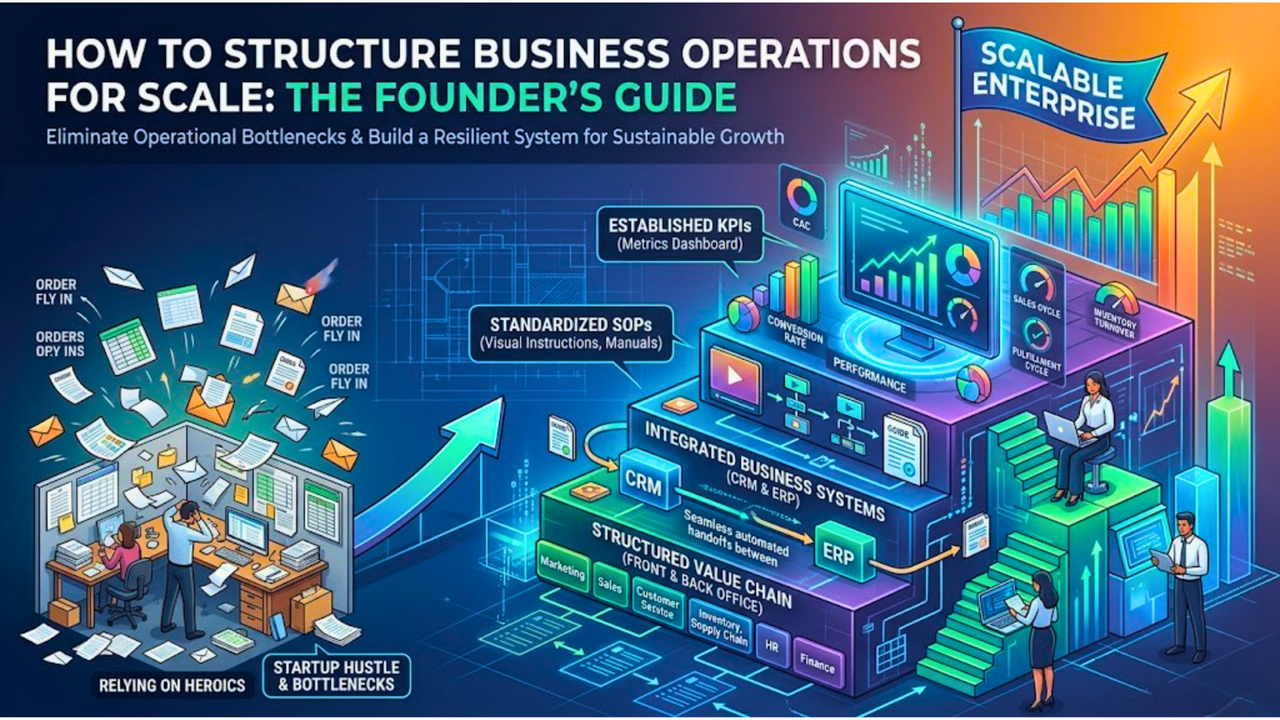
The CEO sits at the top of this fragmented stack, receiving a filtered, delayed, and often inaccurate view of what is happening below. To bridge this gap and truly scale with business system integration, you must address the missing piece in most businesses: unifying your tech stack.
Companies with strong integration achieve 10.3x ROI from their data and AI initiatives, compared to just 3.7x for those with poor connectivity. The integration gap is not a technology inconvenience, it is a direct multiplier on whether your intelligence investments pay off.
4. Data Decay — The Silent Erosion
Even businesses that do have CRM in place face a compounding problem they rarely measure: their data is deteriorating in real time.
B2B contact data decays at 22.5 to 30% per year. If you are not actively refreshing and validating your records, nearly a third of your supposed visibility vanishes every twelve months, replaced by outdated contacts, wrong numbers, duplicate entries, and records that have not been updated since the customer's situation changed.
According to Integrate.io's research, 77% of organisations rate their own data quality as average or worse, a figure that has deteriorated by 11 percentage points compared to the previous year, despite increased investment in data infrastructure.
The Real Cost of Poor CEO Business Visibility
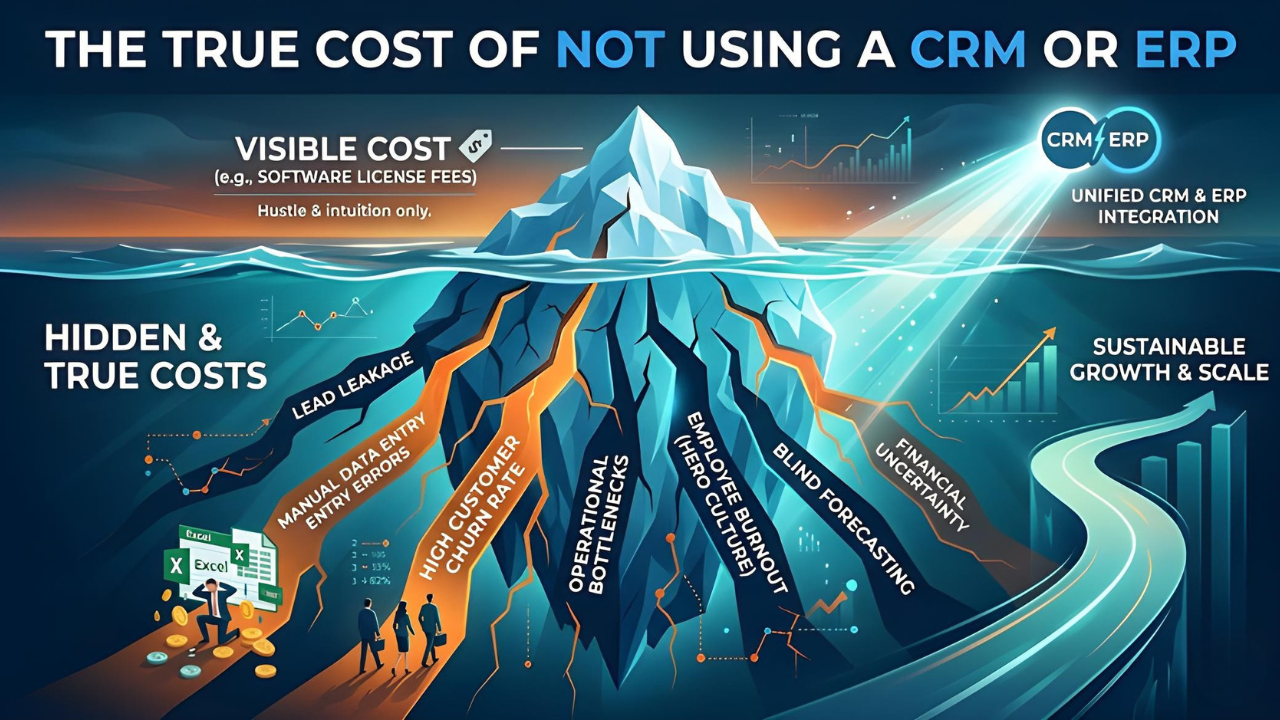
Poor business visibility is not an inconvenience. It is a direct, measurable financial loss — and the numbers are larger than most business owners expect.
The Cash Flow Blind Spot
Agicap's 2025 research found that the average cost of unreliable cash flow forecasts reaches $465,000 annually for mid-market companies. This is not a single catastrophic event. It accumulates quietly: a missed opportunity here, a poorly timed capital decision there, a vendor negotiation that could have gone better with cleaner payables data.
The losses are real but diffuse, no single line item in a P&L says "cost of bad visibility." That is precisely what makes them so dangerous.
The Revenue Leakage Equation
Organisations lose an average of 25% of their annual revenue to quality-related inefficiencies and poor decisions, according to Precisely's 2025 Data Integrity Trends Report. For a ₹20 crore business, that is ₹5 crore a year quietly escaping through the cracks of misaligned systems.
Visibility Gap | Measurable Impact |
71% of leads get no second follow-up | Immediate revenue loss on paid-for leads |
Revenue forecast misalignment | Hiring and investment decisions built on false projections |
Data decay at 30% annually | A third of "known" pipeline value becomes unreliable within 12 months |
27% of selling time lost to bad data | 62 working days per rep per year in non-productive activity |
Cash flow forecasting errors | $465,000 average annual cost per mid-market company |
No churn signal detection | Customer loss discovered 3–6 weeks after it could have been prevented |
The Compounding Effect
The most dangerous aspect of the CEO visibility problem is that individual costs are invisible in isolation. A 5% drop in follow-up consistency doesn't appear on any dashboard. A data accuracy problem that wastes two hours a week per rep doesn't show up as a line item. These losses compound silently, and by the time they are visible in the EBITDA number, the cause is nearly impossible to trace.
As EY's Global DNA of the Treasurer Survey noted, when finance and treasury are working from different data sets, the conditions for forecasting errors, poor liquidity decisions, and strategic miscalculations are set — not through any single failure, but through the gradual accumulation of small, invisible gaps. Proactively addressing these gaps with the right business systems for growth will stop a silent operational collapse before it ever impacts your bottom line.
How CRM and ERP Systems Restore CEO Visibility
From Guesswork to a Single Source of Truth
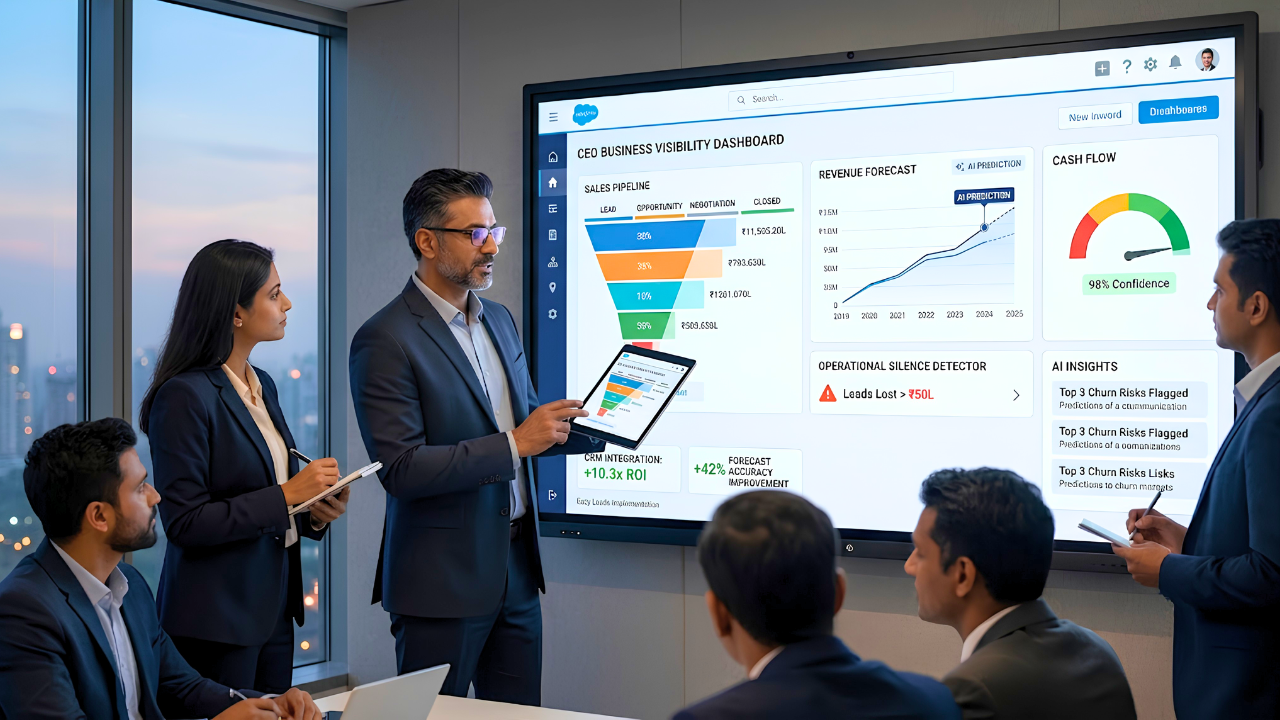
A properly implemented CRM/ERP system eliminates data islands entirely. Every lead, every deal, every customer interaction, every invoice, all of it flows into one connected platform accessible to the right people in real time.
The research on outcomes from this shift is consistent and compelling:
Sales and Revenue Impact:
- 29% average increase in sales revenue (Nutshell, Salesforce, 2025–26)
- 42% improvement in sales forecast accuracy (Salesforce, 2025)
- 26% more deals closed by sales teams with CRM vs. without (Salesforce State of Sales, 2026)
- 41% higher revenue per sales rep compared to non-CRM users (Nucleus Research)
- 21x higher lead conversion when leads are contacted within 5 minutes — which automated CRM makes possible (HubSpot)
- 86% more likely to exceed sales targets for companies using CRM vs. those without (SLT Creative, 2025)
Operational and Strategic Impact:
- 34% improvement in sales productivity through automation of manual tasks
- 8–14% reduction in sales cycle length through better pipeline management and automated follow-ups
- 42% improvement in forecast accuracy — enabling data-driven resource allocation
- 27% higher customer retention rates for businesses using CRM
- $8.71 returned for every $1 invested in CRM (Nucleus Research), with enterprise implementations reporting up to $30.48 per dollar
The most striking finding comes from McKinsey: companies using data-driven B2B sales-growth engines, which rely heavily on CRM and integrated analytics, report above-market growth and EBITDA increases in the range of 15–25%. That is not marginal improvement. That is a structural competitive advantage.
A Real Business Scenario: Before and After
Before CRM implementation: a ₹80 crore distribution company:
- Sales pipeline tracked across 6 reps' personal WhatsApp chats and individual notebooks
- Monthly revenue report took 3 days to compile across 4 separate spreadsheets
- Two reps contacted the same prospect in the same week with different pricing
- Customer churn detected only when renewal conversations were missed, typically 6–8 weeks after the decision
- No visibility into which lead sources were generating profitable customers vs. dead-end enquiries
After Salesforce CRM implementation, same company, 90 days later:
- Full pipeline visible to every leader in real time, updated automatically after every interaction
- Revenue report available in under 60 seconds from a single dashboard
- Automated lead routing system prevents duplicate contacts and assigns ownership with timestamps
- Churn risk alerts flag customers with no engagement in 45+ days, before they have decided to leave
- Lead source attribution shows exactly which channels generate closed revenue, enabling smarter marketing spend
The outcome: 44% increase in visible pipeline value within 90 days, and the first revenue forecast in two years that matched actual results within 5% variance.
5 Signs Your Business Has a CEO Visibility Problem Right Now
Use this as a quick self-assessment. If more than two of these apply, the visibility gap is already costing you money.
- You cannot answer "what's our revenue this month?" in under 60 seconds without asking someone else to compile data
- Your sales forecast consistently misses by more than 15% — either high or low — and the reasons are different every month
- You discovered a customer had churned weeks after it happened — not in real time
- Two people give you two different numbers for the same business metric in the same meeting
- Your best-performing sales rep's departure would take your entire pipeline with them because it lives in their head or phone
Research validation: Businesses with clear pipeline visibility are 2.3 times more likely to hit their revenue targets than those without it (Automatic Backlinks, 2026). The presence of even one of these signs above means your current systems are not giving you the visibility your role demands.
What Real-Time Business Visibility Actually Looks Like
True CEO business visibility is not a 40-page monthly report. It is a live environment where the right information reaches the right person at the right time, automatically.
The Three Layers of Business Visibility
Layer 1 — Sales Visibility
Every lead is tracked from source to close. Pipeline stages are defined and enforced. Follow-ups are automated and timestamped. The CEO can see deal velocity, conversion rates by source and rep, and probability-weighted revenue forecast, without asking anyone.
The research benchmark: Data-driven organisations using CRM are 23 times more likely to acquire new customers and experience 100% increases in visible pipeline value following proper implementation (SellersCommerce, Salesmate 2026).
Layer 2 — Operational Visibility
Inventory, delivery timelines, and service tickets are tracked in real time. Bottlenecks surface before they become crises. The gap between what was promised to a customer and what operations can actually deliver is visible before the commitment is made.
The research benchmark: 92% of businesses report that CRM played a direct role in achieving their income goals, and operational alignment between sales commitments and delivery capability is consistently cited as the primary mechanism (Salesmate, 2026).
Layer 3 — Financial Visibility
Real-time P&L, cash flow forecast, and cost-centre performance are available without a three-day Excel project. Revenue actuals can be compared against forecast with a click, and variance explanations are embedded in the same system.
The research benchmark: Sales forecast accuracy improves by 42% with proper CRM implementation, addressing the root cause of the cash flow confidence crisis that affects 98% of mid-market finance leaders (Salesforce, Agicap, 2025–26).
The AI Dimension: Why 2026 Changes Everything
One of the most significant shifts in the CEO visibility landscape in 2026 is the acceleration of AI inside CRM platforms.
The IBM 2026 CEO Study found that today, 25% of operational decisions are made by AI without human intervention, and by 2030, CEOs expect this to nearly double to 48%. Meanwhile, 60% of executives already regularly use AI to support their decisions (Deloitte Global Human Capital Trends, 2026).
Critically, however, Deloitte also found that while 61% of survey respondents recognise the growing importance of data quality, only 5% are taking meaningful steps to address it. This creates a specific risk: businesses deploying AI on top of fragmented, inaccurate data are amplifying bad decisions, not improving them.
The implication for CEOs is direct: AI-powered CRM features, predictive deal scoring, automated churn alerts, revenue forecasting, next-best-action recommendations, only deliver their value when built on a clean, unified, integrated data foundation. Gartner estimates that 40% of agentic AI CRM projects will fail or stall by 2028 due to data quality problems, not technology limitations.
The right CRM implementation in 2026 is therefore not just about visibility, it is about building the data infrastructure that makes AI genuinely useful rather than confidently wrong.
Choosing the Right System for Business Visibility
What to Evaluate Before Implementation
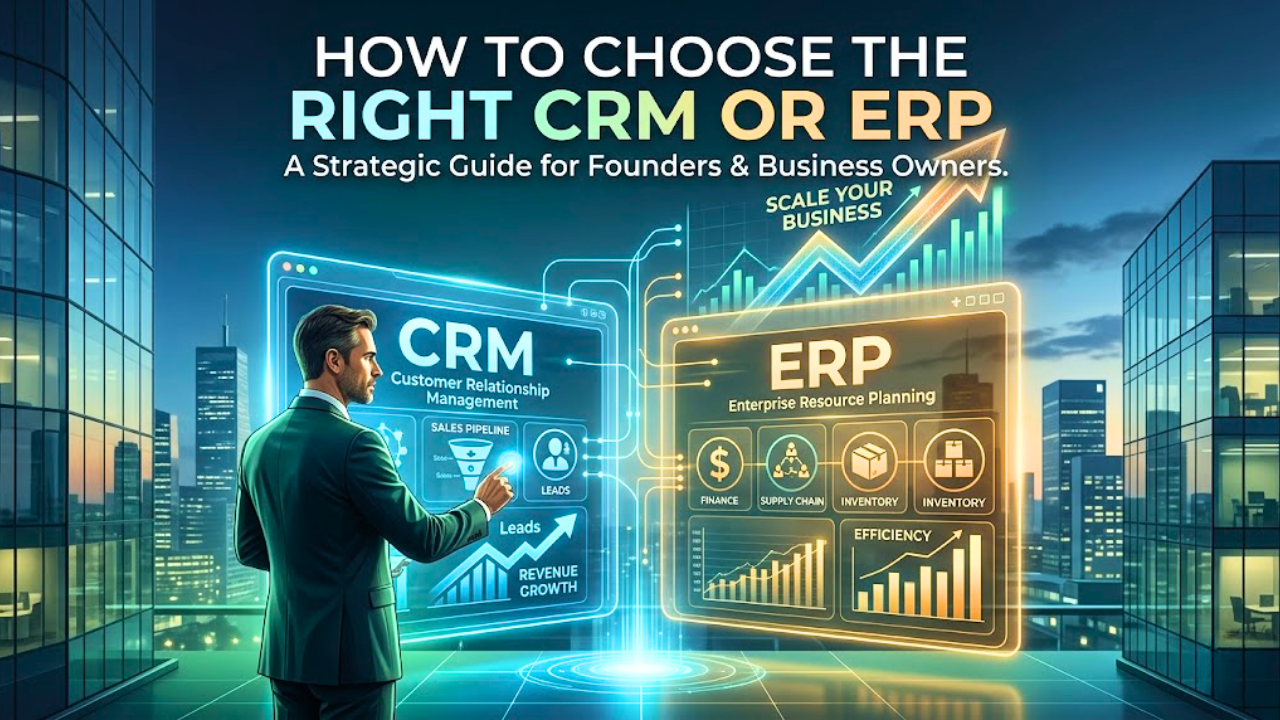
Integration depth is the most critical success factor. A CRM that does not connect to your finance system, inventory tool, and support platform creates new islands rather than eliminating old ones. With 897 average enterprise applications and only 29% integrated, the CRM you choose must be evaluated on its ecosystem connectivity, not just its standalone features.
User adoption architecture determines whether the system actually gets used. Research consistently shows that 42% of businesses cite lack of training and CRM expertise as the biggest barrier to CRM success (CRM.org, 2026). A system your team avoids is more dangerous than no system, it creates the illusion of visibility while hiding the truth even more effectively.
Reporting and dashboard configuration must match how your leadership team actually thinks. Research shows that businesses where CRM metrics are directly linked to executive KPIs are 56% more likely to outperform competitors in customer satisfaction and report sustained double-digit revenue growth.
Why Salesforce Leads for CEO Business Visibility
Salesforce's architecture is built specifically around the unified visibility challenge. Its native connection between Sales Cloud, Service Cloud, Financial Services Cloud, and Data Cloud means a CEO can see a customer's full journey, from first marketing touchpoint to open support ticket, in a single view.
The numbers specific to Salesforce are compelling:
- Salesforce customers report a 35% increase in customer satisfaction post-implementation
- A 44% increase in visible sales pipeline in the first 90 days
- Salesforce Einstein processes more than 2 trillion AI predictions per week for 150,000+ customers
- Salesforce delivered 2.4 billion agentic work units in fiscal 2026, demonstrating the scale at which AI is already operating in the platform
With Agentforce, Salesforce goes beyond passive reporting, it surfaces early warning signals proactively, flagging at-risk deals and churning customers before the CEO needs to ask. For the first time, business visibility becomes not just reactive but genuinely predictive.
People Also Ask
Q: Why do most CEOs lack real-time business visibility?
Most CEOs lack real-time visibility because their business data is stored across disconnected systems — spreadsheets, email threads, WhatsApp groups, and standalone software that do not communicate with each other. MuleSoft's research shows that enterprises average 897 applications with only 29% integrated. Without a unified CRM/ERP platform, every insight requires manual assembly, which introduces delays, errors, and gaps that make the resulting picture unreliable. Only 34% of organisations are confident in their CRM data (Korn Ferry, 2025), meaning the majority of leadership teams are making strategic decisions on information they privately question.
Q: What does poor CEO business visibility actually cost?
The costs are multi-dimensional and compound quietly. Precisely's 2025 research estimates organisations lose 25% of annual revenue to data quality-related inefficiencies. Agicap's 2025 data puts the cost of unreliable cash flow forecasts at $465,000 annually for mid-market companies. At the sales level, 71% of leads are lost to missed follow-ups, and each sales rep loses 62 working days per year to inaccurate data. Gartner estimates $9.7–15 million in annual losses from flawed decision-making. Individually, none of these appear on a P&L as a single line item — together, they represent the most expensive problem most businesses are not measuring.
Q: How quickly can a CRM improve business visibility?
Initial benefits appear within 90 days according to Method's 2026 analysis, with full positive ROI typically within 12 months. In the first 90 days, the most immediate improvements are pipeline clarity (42% forecast accuracy improvement), lead follow-up automation (21x higher conversion for leads contacted within 5 minutes), and the elimination of manual reporting lag. Full strategic visibility — including predictive churn signals, AI-assisted deal scoring, and real-time financial dashboards — typically matures at the 90–180 day mark depending on data quality and team adoption.
Q: Can a small or mid-size Indian business afford CEO visibility tools?
The ROI data suggests the more relevant question is whether they can afford not to. Businesses with fewer than 10 employees have a 50% CRM adoption rate; those with 10 or more are at 91%. The average return on CRM investment is $8.71 per $1 spent, with enterprise implementations reaching $30.48 per dollar. For an Indian mid-market business losing 25% of annual revenue to data inefficiencies, even a modest CRM investment that recovers 30% of that leakage delivers an immediate, measurable return. Cloud-based Salesforce implementations — now representing 87% of all CRM deployments — are significantly more accessible than on-premise alternatives.
Q: What is the single most important thing a CEO should do to improve business visibility?
Before selecting any software, conduct a data audit. Map where your business data currently lives — every spreadsheet, every WhatsApp group, every standalone tool — and identify the specific decisions you are making that rest on data from those sources. This audit reveals the exact visibility gaps and allows you to configure a CRM/ERP implementation around the specific questions leadership needs answered daily, rather than deploying a generic solution that the team works around. Research shows that 40% of CRM features remain underused in organisations without structured onboarding — and companies that invest in comprehensive training and configuration see 30% higher user adoption rates and significantly stronger data accuracy.
Conclusion: Visibility Is Not a Luxury — It Is the Foundation of Every Good Decision You Make
Every strategic decision a CEO makes rests on one assumption: that the information they are using is accurate, complete, and current.
If your data is fragmented, delayed, or assembled by hand — that assumption is wrong. And every decision built on it is compromised.
The research is unambiguous. Only 2% of finance leaders fully trust their real-time data. 77% of organisations rate their own data quality as average or worse. Companies lose 25% of annual revenue to data inefficiencies. And yet businesses with proper CRM visibility are 2.3 times more likely to hit revenue targets, 86% more likely to exceed sales goals, and — according to McKinsey — deliver 15–25% higher EBITDA growth.
The CEO visibility problem is not inevitable. It is a solvable systems problem. The businesses pulling ahead of their competitors in 2026 are not doing so because they have better products or bigger teams. They are doing so because their leaders can see the whole picture — in real time, without asking anyone to compile it.
A properly implemented Salesforce CRM/ERP system does not just organise your data. It gives you back the one thing no amount of working harder can replace: clarity about what is actually happening in your business, right now.
🎯 Ready to See What Your Business Actually Looks Like — In Real Time?
The CEO visibility problem is a mechanical failure of your business architecture. When you rely on fragmented tools, you are forced to make critical decisions based on incomplete, outdated, or inaccurate information.
By prioritizing real-time business visibility through integrated systems, you reclaim control. You replace guesswork with hard statistical facts. You empower your team with pipeline automation, enforce sales pipeline transparency, and unlock true data driven decision making.
Ready to gain absolute visibility into your business? At Symake, we specialize in designing and implementing centralized business systems tailored for ambitious founders. Whether you need a robust CRM rollout or a full-scale ERP integration, our experts engineer the solutions that eliminate data silos and drive scalable growth.
Explore how we can transform your operations, visit our website or discover our specialized implementation offerings of Services. Stop guessing, and start scaling with clarity.